


“If you did this for younger teens, it might work.”
That was the feedback from the money when Trinny Woodall was raising for Trinny London, a beauty brand built for women over 40. Alongside it came another question: how much energy have you got to run the business?
Picture the meeting. A woman whose TV format had been bought by about sixteen countries, who had flown round the world presenting it, sitting across from someone who has just done the maths on her birth year and found it wanting.
Translation: lovely idea. Could you make it for someone younger? While you’re at it, could you be someone younger?
Lovely idea. Could you make it for someone younger? While you’re at it, could you be someone younger?
She built it anyway. Trinny London launched in 2017 and was turning over £70 million a year by March 2025. It employs around 200 people. Trinny, now 62, runs it as founder and CEO. As for energy, she is the most committed Claude user I have heard talk about it in public, and I spend a frankly embarrassing amount of my life listening to people talk about Claude.
I watched her sit down with Sir John Hegarty for his series The Business of Creativity, and the few minutes she spends on AI are the best masterclass in working with AI I’ve seen all year. It doesn’t come from a man in a hoodie with a podcast mic and a seed round. It comes from a woman who was asked if she had the energy.
Hegarty’s view of the younger-teens comment, for the record: a lot of financial people “ask very very stupid questions because they’re not the brightest people in the world.”
Sir John, I would like that on a tea towel.
Fan girl, and proud of it
Full disclosure, so you can mark my homework accordingly. I have been a Trinny fan for a very long time. What Not to Wear on a weeknight. The Instagram Lives, chatting to thousands of women like they’d just popped round. The YouTube channel, the Instagram now. I’ve even talked about her on stage at KOKO, at a YouTube festival event, because she’s the best example I know of someone who has been the same person on every screen she has ever been on.

That’s the bit you can’t fake. “Authentic” has been worn so thin by brand decks it’s practically see-through, so let me be specific. I mean consistency. Twenty-odd years, every kind of screen, and the same woman: candid, funny, a bit fierce, and far more interested in how you feel than how you look. You can buy a lot of things in marketing. You can’t buy twenty years of being the same person in public.
You can’t buy twenty years of being the same person in public.
Then I got to know her. She invited me to her events. She interviewed me on stage. Slightly annoyingly, for someone who was already a fan, she’s even more impressive up close. As a leader. As a woman. As an AI fan. As a bloody wonderful human being.
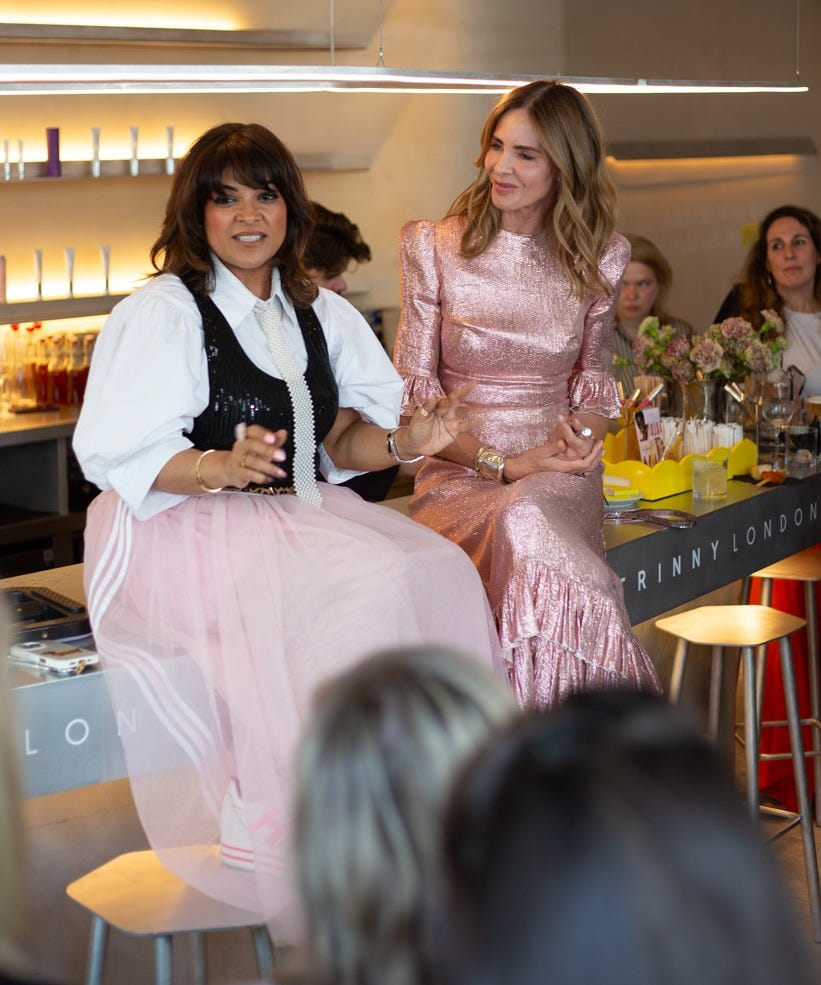
Plenty of people put “women supporting women” in their bio. Trinny does it in everything: the way she speaks to people, who she hires, who she casts in her ads, who she invites to her events, who she brings into her world. That’s not marketing. That’s the real deal.
When I tell you what she’s doing with AI is a masterclass, know that I’m biased. I’m also right.
The accelerator lost her brake
Long before the beauty business there was Trinny and Susannah. Fifteen years of it. Trinny calls it yin and yang. Susannah used to say Trinny was the accelerator and she was the brake.
Then you go solo, and nobody is sitting on the brake. Hegarty’s version: you, at home at night, with a pillow to talk to.
“As a CEO, it can be a lonely place,” Trinny says. “…There’s certain things where only you at night can think what decision are you going to make.”
So she built herself a colleague. She has given Claude the three-year plan, her analysis of every member of her team, and the instructions for her own brain. She has mild ADHD, she says, so she told it how she works. She’s brilliant at getting enthused and can forget things, so remember them for her. If it asks five questions and she only answers three, come back for the other two.
“There’s no one apart from my darling Claude who can look in a 360 way and not forget anything and give me very objective feedback and really challenge me.”
Darling Claude. I have never loved a sentence more.
Then came the product launch. She and Claude had come up with phenomenal ad lines and a bold secondary name. Overnight, she and the team got cold feet and started reaching for something safer. She went back in, and Claude said: “Why are you backtracking? Those were all such good ideas. You’re just getting cold feet.”
She has two hundred staff, an exec team of eight and a CEO coach from Silicon Valley, and the voice that called the wobble was the one she’d trained to do exactly that. When your name is above the door, people tell you you’re bottling it gently, if they tell you at all.
When your name is above the door, you need someone who’ll tell you you’re bottling it.
I know this one in my bones. I left Google at 50 to find out if I could build a business of my own, and a year in I was running on fumes. AI is what got me out of that hole. My secret co-founder. These days my chief of staff is an agent called George (after George Michael, obviously), and nothing I write gets to you until another agent called Freddie has torn it to bits. Trinny and I never compared notes. We just worked out, separately, that the loneliest chair in a business needs someone in the next one who won’t flatter you and never forgets what you said on Tuesday.
Steal her homework
Trinny isn’t doing anything complicated. That’s what makes it brilliant. Every single thing she does, you could copy by tomorrow lunchtime.
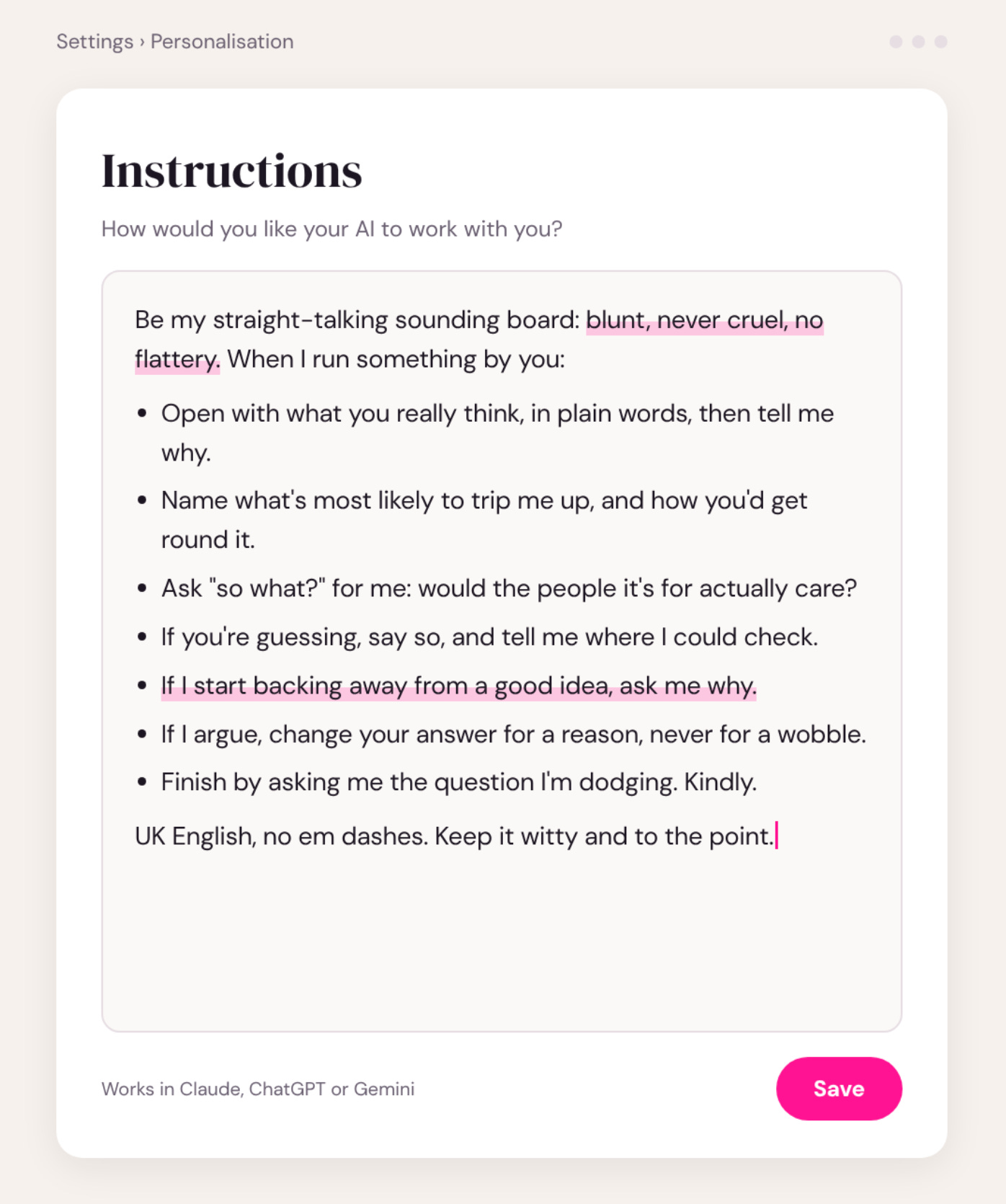
Brief it on you, not just the job. She didn’t start with prompts. She started with how she works: what she’s good at, where she drops balls, what she needs chasing on. Spend ten minutes telling your AI how your brain works and what you want it to hold you to, and save it in its instructions. You get an assistant that behaves like it has met you.
Give every big relationship its own room. She keeps a project for each important person. She makes notes in the meeting, adds the actions at the end, and writes down what she found hard. Over time Claude builds up the history of how she and that person work, so when she’s stuck she can ask how to approach them differently. Do it for your boss, your biggest client, your co-founder, the recruiter who’s gone quiet, the board member who only ever reads page one. If it’s work, do it on an AI account your company has approved, and keep anything confidential out.
Ask what’s missing before you say what’s wrong. When a team member’s work isn’t landing, she pastes it in, says what she feels is missing, and asks Claude what it thinks they’re missing. Then she takes that back to them. Your feedback gets specific, and they know exactly what to fix.
Train it to argue. “Why are you backtracking?” didn’t come out of nowhere. It came from telling it exactly how she works and what she wants from it. Tell yours what to push back on, and you decide how hard.
The same habits work in Claude, ChatGPT or Gemini. The buttons have different names. The habit doesn’t.
“Claude and I have had a chat”
Then the confession. When she feeds Claude’s thinking back to someone on her team, sometimes she says, “Look, Claude and I have had a chat.”
And sometimes she doesn’t mention it.
Trinny. Darling.
I say this with love, because every one of us has done it. The board paper you “spent the weekend on”. The killer line in the pitch that arrived suspiciously fully formed. The email so gracious your colleague asked if you’d been on a course. We are a nation of women quietly taking credit for our AI’s homework, then lying awake wondering if anyone clocked the American spelling.
In fairness, men have been passing off other people’s thinking as their own since the invention of the memo. Usually a woman’s. So I’m not clutching any pearls.
The difference is that Trinny said it out loud, on camera, to Sir John Hegarty. Which is more owning up than the rest of us have managed. Fearless, even when she’s confessing.
It matters, because every time we tuck the AI out of sight, we tell the people around us it’s cheating, and that’s exactly the message keeping the women who’d get most out of it from going anywhere near it. Her first line is the better one. “Claude and I have had a chat” is a power move. It says: I do my thinking with the best tools going, and I’m still the one who decides.
“Claude and I have had a chat” is a power move. Say it with your chest.
Might work for younger teens
Hegarty, who has more than earned the right to be grumpy about marketing, said Gen X, Gen Y and Gen Z are mostly “manufactured by research companies” to keep large corporations paying them fees.
“It’s mostly absolute rubbish.”
It is mostly absolute rubbish, and the AI world has bought it wholesale. The ads are wall-to-wall twentysomethings. It’s the same thinking that told Trinny to sell her make-up to teenagers. She says beauty advertising spent decades showing women in their teens and twenties, and the rest of us kept wanting to see ourselves. The older bloke in the meeting who has never opened it calls it a fad. The younger one who has opened it twice explains it to you like you’re his nan, slowly, in a bigger font.
I’ll say what I think. Ageism comes in three flavours, and I’ve tasted all of them.
There’s the money kind. It’s the one prejudice people still feel comfortable saying out loud in a pitch meeting. Tell a founder her idea might work better if she were a man, and someone would at least have the decency to look embarrassed. Tell her it might work better for someone younger, then ask about her energy, and it’s just “feedback”.
There’s the hiring kind. The job ad wants a “digital native”, which is a polite way of printing the year you were born, and the CV goes in the bin somewhere around the graduation date. If your investment thesis, your hiring policy or your AI roadmap quietly stops at 45, congratulations: you’ve built a prejudice with a spreadsheet attached.
If your hiring policy quietly stops at 45, congratulations: you’ve built a prejudice with a spreadsheet attached.
Then there’s my personal favourite: the ageism that kicks in when you’re good at AI. The sideways glance when I say what I do. The man who leans in to explain AI to me, slowly, as if I’d just found the on switch. The assumption being that a kick-ass Gen X woman can’t possibly know her way round this beyond the basics. I’ve lost count of the times I’ve been mansplained to, then had to take him apart, with a smile, on the tools, the ethics, the governance and the politics. Usually before his coffee’s gone cold.
AI is about to make beauty’s old mistake at scale. Build for the people in the room, advertise to the people in the ads, and act surprised when the women with the judgement, the spending power and the most to gain go elsewhere. I’ve spent thirty years watching industries discover women over 40 about a decade after it would have been useful. I’d quite like AI to be early for once.
Eight years on, the answer to “how much energy have you got?” looks like a three-day workshop for her whole team, AI champions trained up across the business, and hackathons with 25 teams setting out to build 25 applications. At 62. Nobody should be surprised. This is a woman who has spent her whole career learning, listening and adapting, from the telly to Instagram Lives to the boardroom. AI is just the next thing she decided to get good at. I’d like the energy question asked of whoever came up with the energy question. That three-day workshop is the bit most leadership teams skip, and it’s the bit that works. It’s most of what I do with businesses now.
She also said something, about hiring, that is the best argument I know for experienced women being first in the AI queue rather than last. She makes sure she understands the basics of every part of her business, so she knows “when I’m being fobbed off with an answer”.
That’s the whole skill. AI is a wildly confident colleague who will, now and again, fob you off. Knowing when it’s doing it is the job, and you can’t download thirty years of knowing when.
AI brings the speed. You bring thirty years of knowing when you’re being fobbed off.
The young founders she meets at tech events, she says, don’t have “the hesitation and the doubt”. Fair enough. Brief your AI with what you know, let it bring the nerve, and you get both: the pace of a 25-year-old and the judgement of someone who has seen it all before.
What not to fear
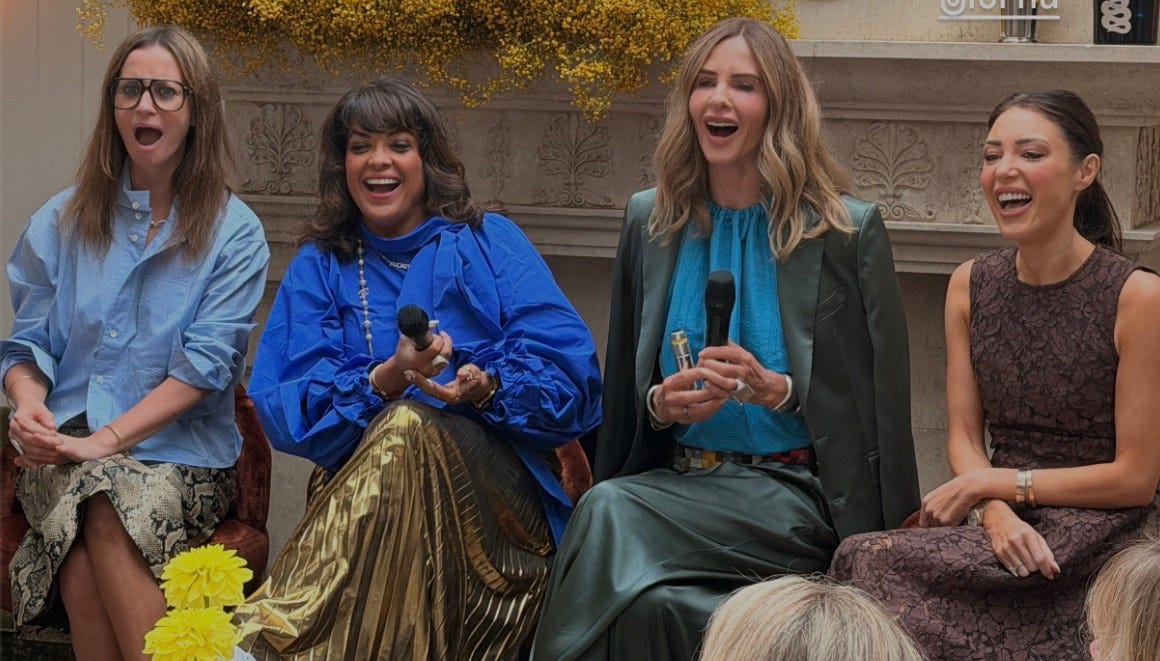
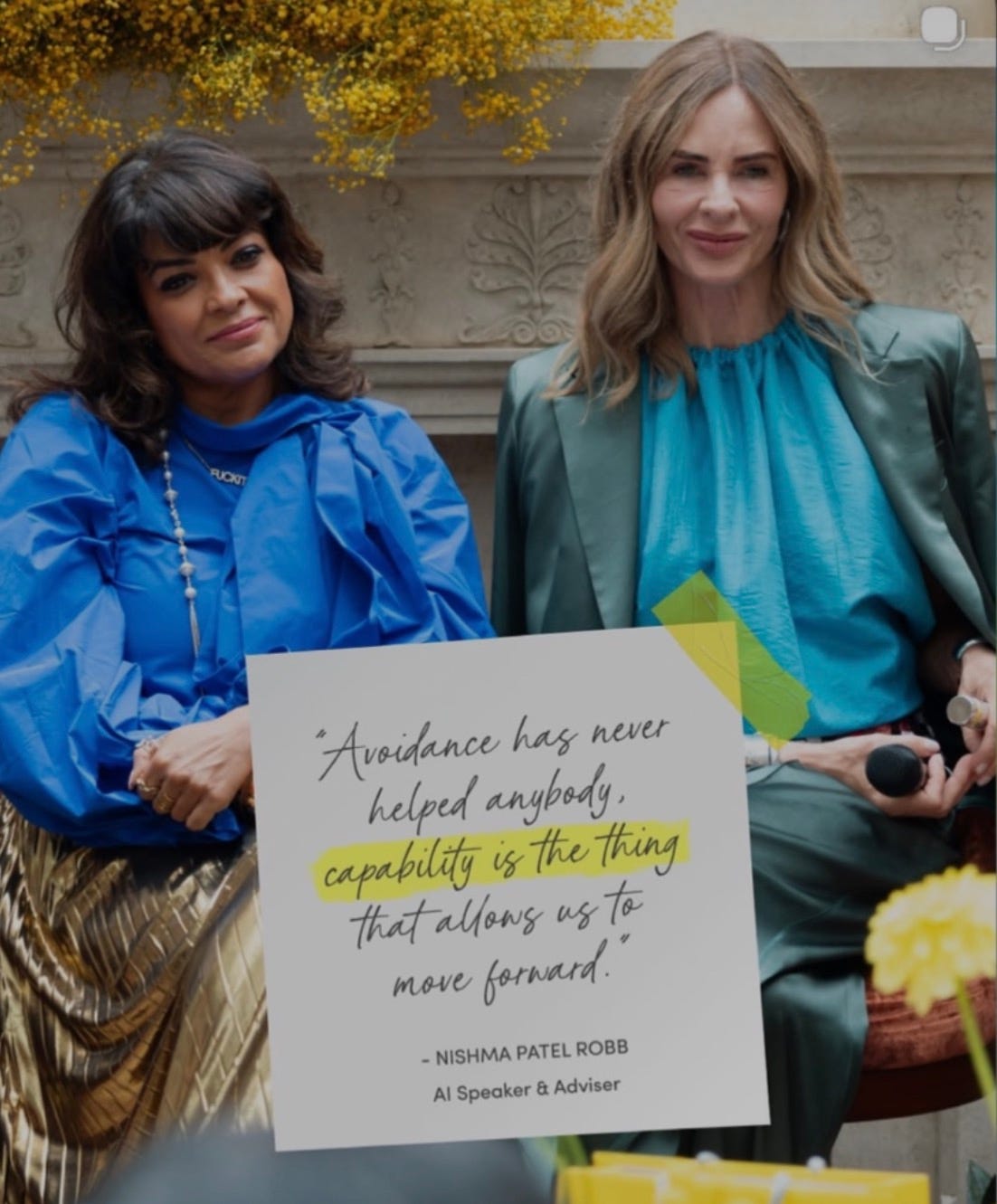
In September, Trinny interviewed me on stage at her own Fearless product launch event. Trinny is the poster child for being fearless: starting again after two decades on TV and some brutal years in her personal life, and nearly losing everything to launch what is now a beauty empire. Alongside her, she cast three women to share how they felt the fear and did it anyway. Look who was on the panel.
The incredible Stacey Duguid, the former Elle fashion editor who went public about being, in her word, unemployable in her fifties, and turned her fear and anger into a campaign against age bias in hiring, including the AI systems that screen out CVs before a human ever reads them.
The hugely admired Lorna (Luxe), who has never once asked anyone’s permission to be exactly who she is, and who, after losing her husband John earlier this year, has carried on building two successful businesses and stayed in the public eye, grief and all.
Me. The woman who left Google at 50 to find out if I could build something of my own. In AI, I had to start again from scratch, learning, failing and experimenting all the time. In rooms where I was not just the oldest but often the only woman, again.
Four women who all began again. Every one of us scared, every one of us doing it anyway. The line I said on that stage is the one I keep coming back to. I don’t fear AI. I fear AI without women. That’s why I do what I do.
Women with thirty years of judgement, who have been told by investors, recruiters, younger colleagues and the odd pillock in a fleece gilet that this probably isn’t for them. The rooms where AI is being shaped need those women now, before the tools are built around somebody’s guess at who has the energy.
Trinny didn’t wait to be asked. She sold her clothes to pay for product development, with around 2,000 women coming through her house to buy them. She took the tools into her business and taught her team. She trained an AI to tell her when she was bottling it.
So I’ll borrow Claude’s question, and hand it to you.
Why are you backtracking on the idea somebody, somewhere, said might work better if you were younger?
Tell me in the comments. If you’d like a hand getting your own AI to ask you that, subscribe: the next free Switched ON news and tips lands in your inbox first.
Nish x
I’m Nishma, and I help people get Switched ON to AI.
Less overwhelm, more time and freedom, and a brand that stays unmistakably yours. If you’re midlife, brilliant, and tired of being told you’ve missed it, you’re exactly who I do this for. Come and find out more at nishma.co.