


The brand industry has spent thirty years perfecting polish. Every touchpoint considered. Every pixel approved. Every word run through legal, then compliance, then a committee of people whose job title includes the word “alignment.”
And look, it worked. For a while. I know because I was one of the people making it work. Ten years at Google, hand on heart, I’d like to think I was good at it.
But something shifted. Slowly at first, then all at once. The most polished brands started sounding identical. The most considered campaigns started feeling the least human. And the audience, the actual living, breathing, bullshit-detecting humans we’re all trying to reach, started doing something that should worry every brand director on the planet.
They stopped giving a shit.
The Mess Premium
Right, here’s a provocation that would make most brand directors need a lie down: when AI makes polish free, mess becomes premium.
Sit with that for a second. Any business can now produce flawless copy, perfect visuals, seamless video content in minutes. The barrier to looking professional has collapsed to basically zero. Which means looking professional is no longer a signal of quality. It’s a signal of nothing. It’s wallpaper. It’s beige. It’s the brand equivalent of a “Live, Laugh, Love” sign on an office wall.
Rory Sutherland has this beautiful idea that the opposite of a good idea can also be a good idea. The brand industry decided decades ago that consistency, polish and control were the good ideas. The opposite of those, inconsistency, imperfection and surrender, sounds like career suicide.
But what if it’s actually where the value has migrated?
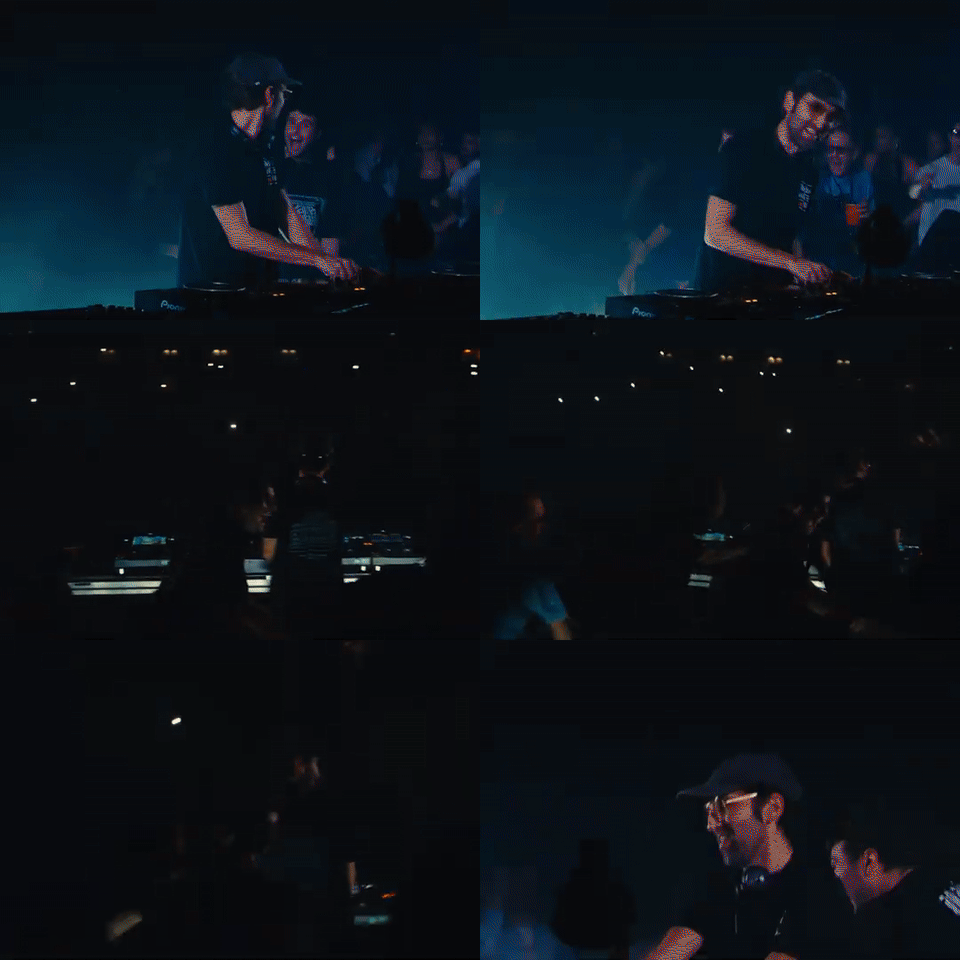
Fred Again live-streamed himself producing a track called “Talk of the Town” on Twitch. Twenty-seven minutes. False starts, dead ends, moments where he clearly didn’t know where it was going. Thousands watched. Not because it was polished. Because it was true. The creative struggle was the content. The vulnerability was the brand signal.
And I say all this as a slightly obsessed (is that a thing?) fan, by the way. I’m genuinely envious of everyone who got to experience those recent Alexandra Palace shows. Fred is an incredible artist and DJ, and the fact that he’s also, almost accidentally, produced the most interesting brand strategy I’ve seen in ages, just makes me like him even more.
Because people keep calling him “messy” or “raw” like he’s winging it. He’s not. Look closer. The hoodie. The phone selfie album artwork. The Twitch streams. The fan photos becoming the Spotify covers. There’s a clear, unfussy, unmistakably Fred aesthetic running through every single touchpoint. That IS brand consistency. It’s just anchored on being human rather than being polished. On being for the fans, not for the machine. On delighting people, including himself, rather than impressing a brand committee.
This isn’t the absence of brand strategy. It’s a masterclass in it. He’s abandoned the old rules of perfection and protection in favour of something messy and accessible and, honestly, something that every brand claims to be but almost none of them actually are: genuinely, lived-on-the-floor, customer-centric. Not as words on a strategy slide. As the actual thing.
And the numbers back it up. Fred went from 53,000 to over 18 million monthly Spotify listeners without a traditional hit single. He sold out Alexandra Palace in minutes. His Boiler Room set has been viewed over 40 million times. These aren’t vibes. These are receipts.
Now when was the last time a top 250 company showed you something they hadn’t figured out yet? Exactly. They’d rather show you a 47-slide deck about their “authentic brand journey” that took six months and four agencies to produce.
The irony is painful.
Collaboration as Compound Interest
The conventional brand playbook says: protect your positioning, own your narrative, control the message. Fred’s playbook says: bring other people in, platform them, and let the whole thing grow in ways you didn’t plan.
When he brought Bangalter from Daft Punk on stage, or sampled a stranger’s voice note, or invited a 16-year-old Slovenian dancer to freestyle for a music video, he wasn’t diluting his brand. He was compounding it. Every collaboration added a new audience, a new story, a new reason for someone to care. His generosity wasn’t charity. It was growth strategy. And it takes proper balls to do that, by the way. To stand on your own stage and go “actually, watch THIS person.”
Zoe Scaman has written brilliantly about how modern fandom is built on participation, not consumption. The brands that understand this are pulling away from the ones that don’t. Look at what Duolingo has done on TikTok. The owl is barely selling language lessons. It’s creating a world that people want to be part of, to riff on, to remix.
The audience isn’t watching the brand. They’re making it.
Now think about what most personal brands look like on LinkedIn. Carefully curated. Relentlessly self-referential. Every post engineered to position the author as the expert. The generous move, the Fred move, is to make someone else look brilliant and trust that it comes back. Most people can’t do it because it requires genuine confidence. Not the performed confidence of a thought leadership post, but the real kind. The kind that says: I don’t need to be the smartest person in this room. I just need to be the one who made the room worth being in.
Designing for Presence in an Age of Infinite Scroll
Fred tells his audience not to film. He hands out stickers to cover phone cameras. He drops tickets via WhatsApp with days of notice. He releases tracks with blank artwork that only gets filled in the morning after the show, with photos from the actual crowd.
Every single one of those decisions is a bet against reach and a bet on presence.
This is heresy in marketing. We’ve built an entire industry around maximising impressions, optimising for eyeballs, extending the content lifecycle. And here’s someone deliberately constraining it. Making things harder to access. Less shareable. More ephemeral.
And it’s working better than anything the optimisation playbook ever produced. Which, honestly? Makes me want to laugh and cry in equal measure, because I spent a decade optimising the hell out of everything.
Because “you had to be there” is doing something no algorithm can replicate. It’s creating memory. Not content, not impressions, not a data point in a dashboard. Actual human memory. The kind people carry with them, talk about at dinner, text their friends about at midnight. The kind where a 35-year-old man cries at a show and tells everyone about it the next day without a shred of embarrassment.
What would it look like if more brands designed for that? Not a webinar with 10,000 registrations and 400 attendees half-watching while checking email. A room of 50 people who chose to be there. No recording. No replay. No deck afterwards. Just the experience and the conversation that follows it.
Imagine a product launch where the only people who see it are the ones who showed up. A customer event where the phones go away. A brand moment designed to be remembered, not repurposed.
It sounds commercially reckless. I think it might be commercially genius.
You’re going to want to keep reading.
I’m about to tell you exactly what this looks like on a Monday morning. The practical bit. The bit you can actually steal. But I need a favour first.
I can’t rely on the algorithm to show you my stuff. It’s a fickle beast and frankly, it’s not on our side. But if you hit subscribe, you’ll get every story I write, straight to your inbox. It’s free. No catch. I just want to make sure the people who actually want to read this, can. And selfishly, it makes it worthwhile for me to keep writing. Please Subscribe for FREE
Already subscribed? You legend. Keep scrolling.
Yeah, But My CFO Would Kill Me
I know what you’re thinking. Nishma’s been at the Lion’s Mane again.
“That’s lovely for a musician, but if I posted unfinished work my stakeholders would have me escorted from the building.” Fair. I hear you.
And let’s be honest about survivorship bias while we’re at it. For every Fred there are thousands of artists showing their messy process to absolutely nobody. The mess alone isn’t the magic.
The magic is mess plus mastery.
Fred can afford to show the dead ends because when he finds the right path, it’s extraordinary. The vulnerability works because the talent is undeniable. Mess without substance is just... mess. And we’ve all seen enough of that on LinkedIn to last several lifetimes.
So what does that mean for the rest of us? You don’t need to be a musical genius. You need to be genuinely good at your thing and willing to let people see the process of getting better. A consultant sharing the framework they’re still testing. A founder showing the product decision they’re wrestling with. A strategist publishing the brief they haven’t cracked yet.
The bar isn’t perfection. It’s proof that you’re actually in the arena, not just commentating from the stands in a nice jacket.
The Trust Architecture of Imperfection
I got this wrong for years, and I’m not too proud to say it. I spent a decade at Google where brand consistency was gospel. I helped build campaigns that won awards and moved metrics. I helped launch Bard (Gemini v1) in the UK, for God’s sake. I know what good looks like inside a machine. Every asset aligned. Every campaign on-model. The brand guidelines were thicker than some books I’ve read (or wanted to!). And I believed in that. I was good at it.
But consistency and control solve for a world where people trust institutions. We don’t live in that world anymore. That world packed its bags somewhere around 2016 and hasn’t come back. Trust has migrated from institutions to individuals, from polish to proof, from what you say about yourself to what other people say about you when you leave the room.
Fred’s hoodie isn’t a costume choice. It’s a trust signal. It says: I’m not performing for you. I’m not trying to sell you anything. I’m just here. And in a landscape where every other visual signal is saying BUY THIS, CLICK HERE, I AM IMPORTANT, the absence of performance becomes the most magnetic thing in the room.
This is what I mean when I talk about ‘Bathroom Chat’ in the VIP Club framework. It’s the thing people say about your brand when you’re not there to manage the narrative. Fred’s bathroom chat is extraordinary: “I cried at his show and I’m a 35-year-old man and I don’t even care.” You can’t manufacture that in a brand workshop with Post-it notes and an overpriced facilitator. You can only earn it by being consistently, almost recklessly, yourself.
What This Looks Like on Monday Morning
Alright. Enough philosophy. Let’s get practical, because I know some of you are itching to actually do something with this.
If you’re a founder: stop polishing your launch deck and show 50 potential customers the ugly prototype. Seriously. Let them watch you build the thing they asked for. Their investment in your process becomes their investment in your product. It’s not weakness. It’s the smartest sales strategy nobody’s using.
If you run a professional services firm: publish the thinking you haven’t finished. Share the problem you’re wrestling with, not just the case study you’ve already won. I spent years presenting everything as a finished success story. The pieces that actually landed, the ones that got me invited back into rooms, were the ones where I said “honestly, I’m not sure about this bit yet.” People leaned in. Every time.
If you’re building a personal brand: your audience doesn’t need another expert. God knows LinkedIn has enough of those. They need someone who’s visibly, actively figuring it out. In real time. With them. The relationship of the future isn’t “I admire you from afar.” It’s “I feel like I’m building this with you.”
Fred was invisible for years. Producing for Ed Sheeran, Stormzy, Brian Eno, and nobody outside the industry knew his name. Then he stopped trying to be polished and started trying to be present. Within three years he was headlining Glastonbury.
That’s not a music strategy. That’s a brand strategy. And the really uncomfortable question it poses is this: what are you still polishing that would work better if you just shipped it?
Go on. I dare you.
Nishma x
Powered by glitter. Opinions all mine.
I broke down Fred’s brand using my VIP Club framework in this week’s YouTube video. If you want to steal the cheat codes to build an Unmissable brand, the full visual walkthrough with all the evidence, is here.
If you want to nerd out on this further or just have a good debate about it, comment below in my ‘virtual dance floor aka the comments section’ and let’s discuss. 🪩

I can’t rely on the algorithm to show you my stuff. It’s a fickle beast and frankly, it’s not on our side. But if you hit subscribe, you’ll get every story I write, straight to your inbox. It’s free. No catch. I just want to make sure the people who actually want to read this, can. And selfishly, it makes it worthwhile for me to keep writing. Please Subscribe for FREE
This is so, so interesting and heartening for me too at this point! Thank you.