


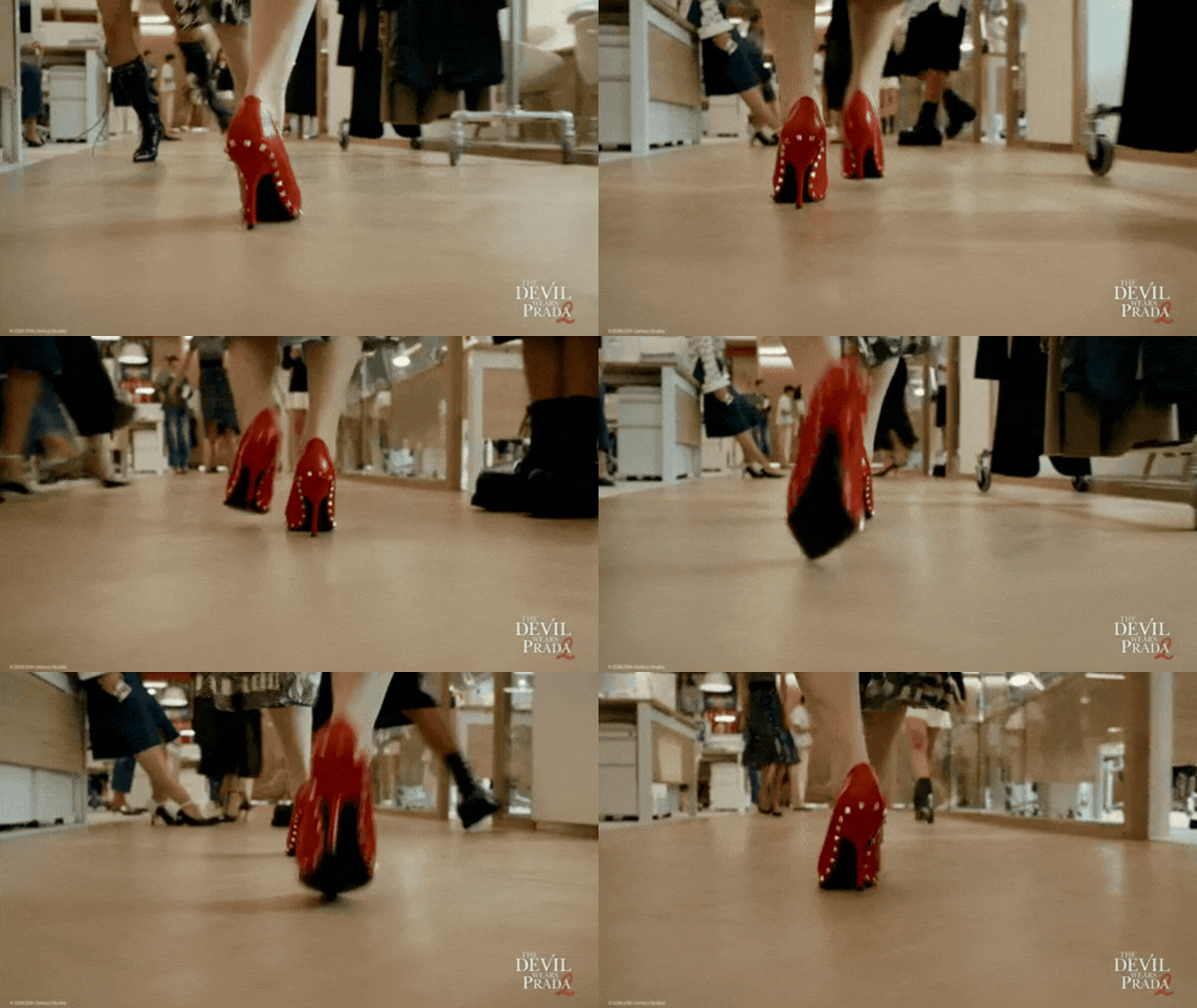
AI is the most forgiving place in your working life to practise being Miranda Priestly.
The title isn’t a joke. Stay with me.
Most women I know have been socialised to apologise for the exact behaviour Miranda got promoted for. We cushion. We caveat. We “would it be possible to...” and “sorry to push back, but...” We spend entire careers being polite about mediocre work because the cost of directness is being called ‘difficult’.
AI doesn’t care.
AI doesn’t get its feelings hurt. It doesn’t go to HR. It doesn’t tell the rest of the department you’re a nightmare at the Christmas party. It just gets sharper.
Which means the first AI skill worth building has nothing to do with prompts, and everything to do with permission.


I HAD A HEAD START. STILL GOT IT WRONG AT FIRST.
Context first, because otherwise none of this makes sense.
When I skipped out of Google, fresh from helping launch Bard v1 (Google’s first gen AI product, aka Gemini v1), I made a decision to learn about all different types of AI. I’d only really been absorbed in one system for quite a few years. I wanted to understand everyone else’s.
For eighteen months I went wide. Every model people were posting about, every workflow, every tool. ChatGPT, Claude, Gemini, Perplexity, Midjourney, Mistral. Some of it was genuinely useful. A lot of it was hype.
For the last six months, that curiosity got serious. Partly because I wanted to grow my businesses and organise my life. Partly because I’m a tech geek and I know that good tech can be transformative to our lives. Mostly, if I’m honest, because I’ve burned out twice in my career and I refuse to do it a third time. AI was the first tool in years that felt like it might genuinely help.
So I had context. I had access. I had time. And I still got it wrong at first. Properly wrong.
I asked AI to write everything for me. Emails. Captions. Proposals. Whole decks. I accepted whatever came back. The outputs were bland. None of it sounded like me. Every ‘hit-send’ felt a little gross. I discarded it for a while.
I was, to be clear, doing the thing everyone warns you about. Letting AI author me. Not amplify me.
If you’ve been there, and most of the women I speak to who “gave AI a go and it didn’t work” have been there, you are not alone. That is the point at which most people give up. I understand why.
Then I shifted.
I stopped asking AI to write for me and using it like a glorified search engine. I started using it as if it were my brilliant colleagues I missed from Google, the ones who pushed me, questioned me, made me go deeper.
Not an author. A sparring partner.
Also, honestly: I got a patient assistant I could get a little Miranda with.
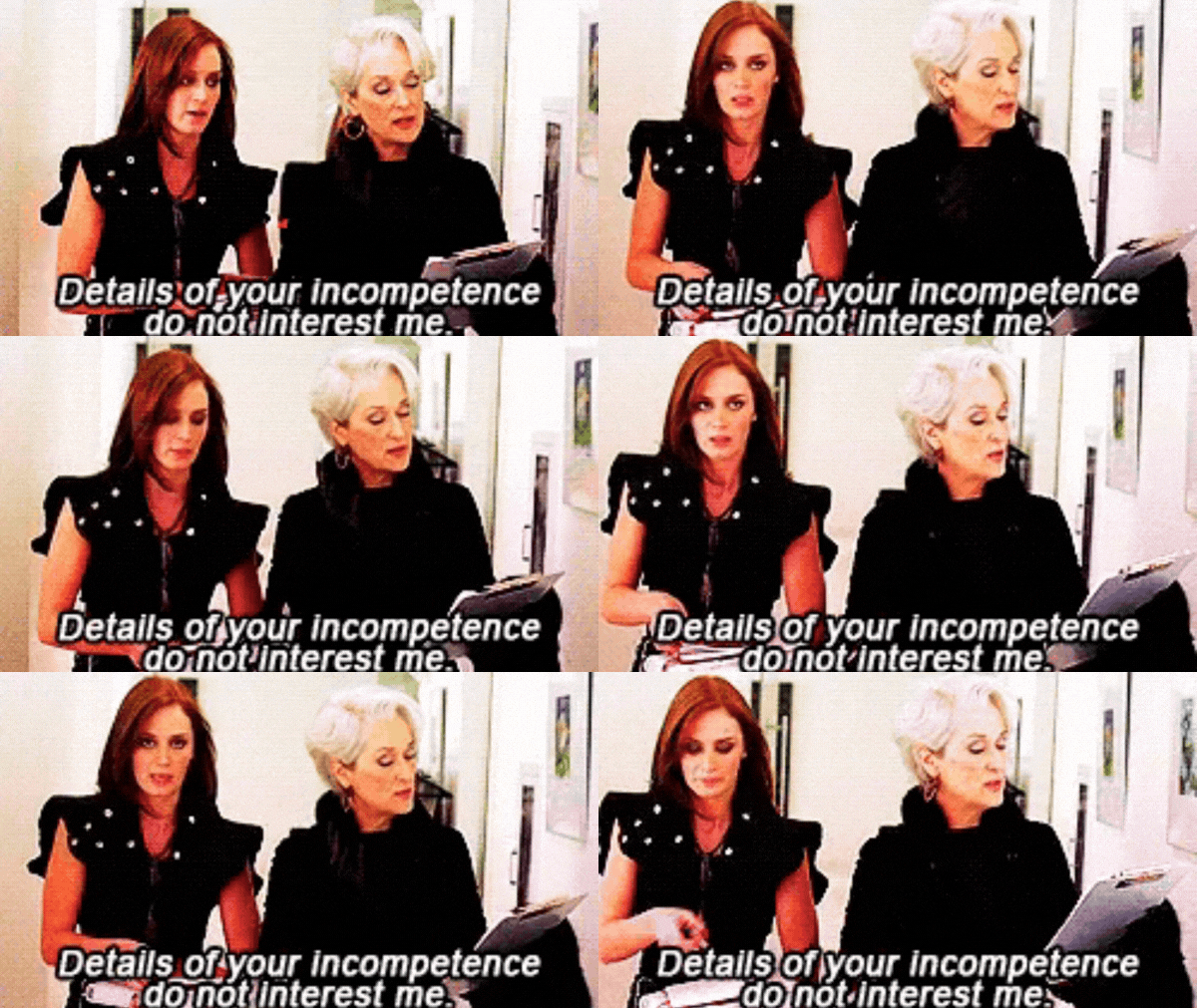
THE MIRANDA REFRAME
The bit nobody wants to say out loud about AI: it will hand you mediocre work if you accept mediocre work.
Say “thanks, that’s great” to a bland first draft and you will get more bland first drafts for life. Say “no, the tone is wrong, try three angles not one, don’t be saccharine, don’t use the word ‘dive’,” and the work gets sharper every single time.
Those are Miranda Priestly’s rules. Standards. Clarity. Zero tolerance for nonsense. Minus the cruelty, obviously. Take the directness, leave the meanness.
“Florals? For spring? Groundbreaking.”
And every woman I know has been trained out of all three.
We cushion. We apologise. We soften. We spend entire careers being polite about mediocrity because the social cost of directness is high.
Two studies, a decade apart, identical numbers.
2014, Kieran Snyder: of women who received critical performance reviews, 76% got personality criticism. Abrasive, bossy, emotional. 2% of men.
2024, Textio’s analysis of 23,000 reviews: 76% of high-performing women received negative feedback. 2% of high-performing men.
A decade. An entire “Women in Leadership” industry. The numbers have not moved. We are not imagining this.
AI removes the social cost. It doesn’t care about tone. It doesn’t go quiet at meetings. It doesn’t tell your boss you’re difficult.
Which means AI is the most forgiving place in your working life to practise being direct. To practise saying what you want, precisely, without the apology. To practise high standards without paying for them.
(Do it with AI enough times and you’re a lot more likely to do it with humans. You’re welcome.)
THREE MOVES FOR MONDAY
If you take nothing else from this essay, take these.
First, stop accepting the first draft. “That’s nice, thank you” is never the correct response to an AI output. “No, the tone is wrong, try three angles not one, don’t be saccharine, don’t use the word ‘dive’” is. You’d be astonished how much sharper the second draft is when you tell the system the first one was mediocre. Directness that would get you a quiet word in a real office gets you better work every time.
Second, train it on you. Feed it examples of writing you’re proud of and ask it to explain what makes them sound like you. It will return a rule-set you didn’t know you had. Ask it to interview you further to really understand your voice and style. That rule-set becomes the brief for everything else. This is the single most underrated move. Most people skip it and wonder why nothing AI produces sounds like them. Of course it doesn’t. You haven’t introduced yourself.
Third, disagree with it. When it agrees with you too quickly, push back. “What’s wrong with my argument? Where am I hiding? What am I not seeing? What would a smart critic say?” Treat the answer seriously. Half the time it catches something you were flinching from. It sees the gaps in your thinking, or the patterns you weren't aware of.
Those three moves have done more for my working life than any productivity hack of the last five years!
THE SECOND HALF OF THE METAPHOR
Miranda isn’t the whole story.
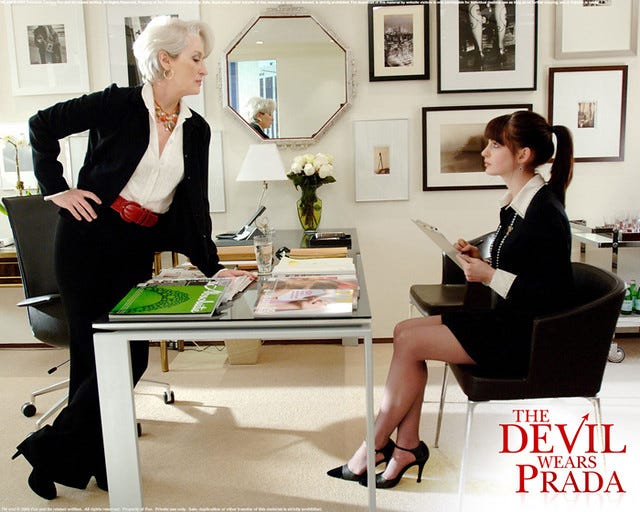
AI isn’t just your assistant. AI is also Andy.
Andy arrives at Runway clueless. Cerulean sweater. No taste. Laughs at the two belts. By the end of the film she's the one who could give the Cerulean speech herself. The one who understands. The one everyone listens to.
AI does the same arc. You train it. It learns you. It catches your rhythm. It brings you references you didn’t know. It disagrees with you when it should. And one morning you open it and realise, shit, this colleague actually knows me.
Give it time. Give it direction. Give it standards.
Which is, if you squint, exactly what Miranda was doing to Andy the whole time. Not cruelty. Clarity.
That is the cognitive friction I missed most about leaving Google. The stretchiness. The brilliant minds around me who kept me sharp and a bit on edge. The thing that gets you out of your algorithmically-curated bubble and into the part of your brain that does its best work.
What surprised me was realising I could build it. One patient Miranda at a time. One trained Andy at a time.
Claude is my AI of choice. It's just been named Webby Person of the Year 2026, which I find quietly delicious for an essay called "The Devil Wears Claude." Systems and processes transfer to other tools, but this is the one that taught me how to be more Miranda.
WHY I AM WRITING THIS THIS WEEK
You probably saw the Reese Witherspoon post on 15 April.
She was in a book club the day before. Ten women. Three used AI. Only one felt like she knew what she was doing. Then she went on Instagram and said this, unfiltered, to 30 million followers:
🤖 “If you don’t get a little bit of understanding from the very beginning, it just speeds past you. You have to have little bits of learning to keep up. Our kids are all using this every single day. It’s time. It’s time, people.”
She’s right. She was describing, almost word for word, the room I’ve spent a year building.
And then I read every single comment underneath her post.
READING THE COMMENTS
There were thousands. Most of them were not applause. A handful that stuck with me:
🤖 “Please start your education with data centres. The amount of electricity they use. The dire effects on communities where they’re being built.”
🤖 “We aren’t being left behind. We are refusing a future that isn’t designed for us. Use your privilege to resist instead of acting like this is all inevitable.”
🤖 “Personally, I’m extremely proud of 7 out of 10 women not using AI.”
🤖 “This feels like a set up for some highly sponsored future content.”
Every one of those concerns is real. Environmental. Ethical. Creative. Financial. I share them. I’ve been turning them over for a year.
And I am still going to say this out loud.
Opting out of AI right now is not a neutral choice. It’s a decision to be optimised away. Slowly. By men using tools you didn’t learn.
Because while you wait for the technology to become safer, or more ethical, or less bro, the rules for how it works, what it does, who it serves, and what it replaces are being written in rooms that are overwhelmingly male.
The answer to concerns about AI is not to leave the tools in the hands of the people who share none of them.
The answer is to learn the thing and use it differently. Bring taste. Bring ethics. Bring the lens it’s currently missing.
Opting out isn’t resistance. It’s ceding ground.
The reason I'm not opting out is more personal than political.
TWO BURNOUTS IS A TREND
The other thing I want to say, because it’s the real stake for me.
I've burned out twice in my career Hard. Both times at a level that was obvious to everyone around me and dismissible by me. That was the version of womanhood I grew up with. Just push through.
Two burnouts in a lifetime isn’t a mistake. It’s a trend. I am not interested in making it a three.
When I talk about AI giving me time back, I am not talking about a productivity hack. I am talking about survival. I am talking about a working life that doesn’t require me to sacrifice my body, my brain, or my relationships to stay in it.
Dishwashers did this for cleaning. Washing machines did this for laundry. Email did this for memos. AI is the next thing in that line. It is the household appliance of the brain.
I have watched too many brilliant women leave work not because they didn’t want it, but because the shape of the work didn’t bend for them. AI can bend the shape of the work.
That’s not a small claim. That’s the whole thing.
WHAT REESE POSTED AFTER THE ORIGINAL CLIP
A few days after the original clip, Reese shared a LinkedIn post by a woman called Keren Camou. One line in it stopped me mid-scroll.
“Most women founders aren’t behind on AI. They’re not in the right rooms.”
That’s the whole pitch I’ve been trying to write for a year.
THE CASCADE
If I help a hundred women get good at AI, those hundred can help a thousand. Those thousand can help ten thousand. This is more than a movement. It’s an urgency.
And it has to be the women in the room helping the next women into the room. Because if we wait for the companies building this technology to think of us, we will be waiting a long time.
I spent years at Google working on closing the digital skills gap. The programme I was involved in reached more than a million people. It changed lives. I have seen what happens when women get access to the tools the economy runs on.
AI is ten times that. Easily. And the gap is opening faster than the last one did.
I don’t have ten years to move the dial. Neither do you.
A SMALL CONFESSION ABOUT V2
I should tell you, because otherwise the story of Glittersphere V2 won’t quite make sense.
This version wasn’t the plan. Four years ago I scribbled in a notebook what I actually wanted to build: women, together, in rooms designed to help each other shine. That was it. Somewhere between the notebook and the first launch, I wobbled and built V1 around what I thought was needed rather than what I instinctively knew.
Mistakes made. Lessons learned. Properly owned.
V2 is the return to the notebook. Events-led, because the magic was always in bringing women together. Nowhere else.
The AI bit was a discovery, not a design. A few months ago, a friend saw what I’d built with AI for my business and my life. Her face did that thing that only good friends can make. And then she said something that made me go home that night and rewrite the plan.
That’s why Glittersphere: Sparkle + AI exists. That’s why V2 is not the version I originally planned. And that is why I am finally writing this down.
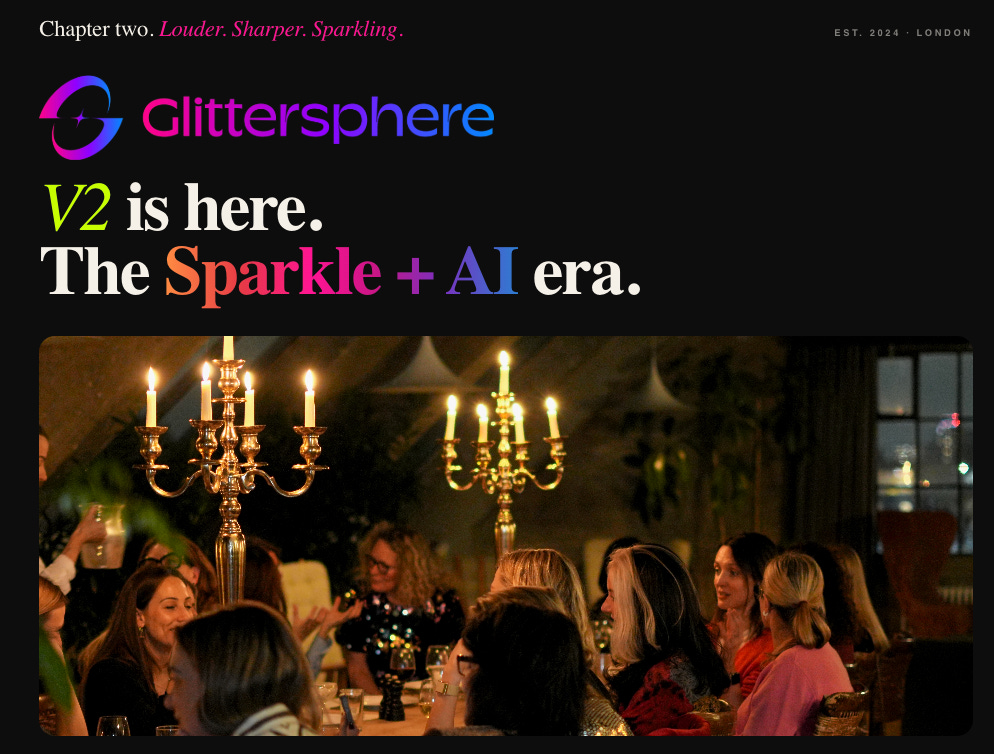
Glittersphere V2 is live today.
It is the room where this idea gets practised, in person, in London.
First event: the AI Supper Club, Tuesday 20 May.
Full info (events, membership etc): glittersphere.com
To the V1 founding members who stayed with me through the rebuild: your trust means the world. Proper thank you this week. 💖
One line to leave you with, because I’ve been saying it to myself like a mantra for three months:
You are not here to ask AI for permission. You are here to give it direction, ideally with sequins on.
Sparkle + AI.
Nishma x
Partnered with AI. Powered by glitter. 🪩
If you enjoyed this post and think someone else might enjoy it please feel free to share it.🪩
Thanks for reading Unmissable! Subscribe for FREE to ensure you receive new posts as you know those naughty algorithms cannot be trusted to share all the posts and because it would make me so happy! 🪩