


Sixty dollars and a soldering iron.
That’s the going rate for removing the small white light on the side of a pair of Meta’s glasses. The light that comes on when the camera does. The light whose whole job is to tell you that you’re being filmed.
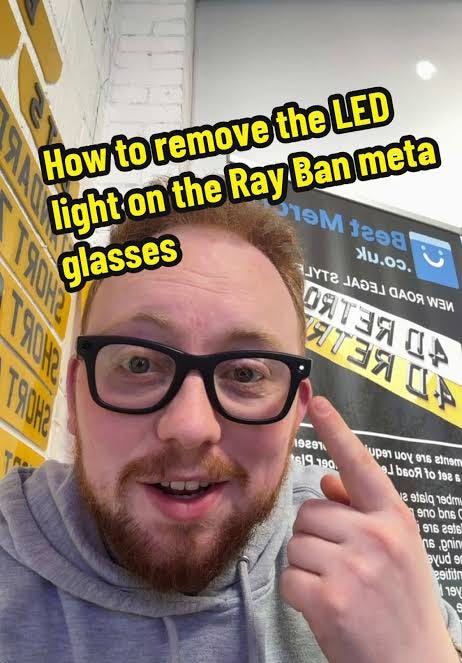
Somebody worked out how. Then a lot of somebodies did it, and this summer Meta pushed an update that permanently kills the camera on any pair where the light has been drilled out. Thousands of pairs, bricked.
Sixty dollars to film without telling anyone. A software update to make you stop. That’s the state of the art.
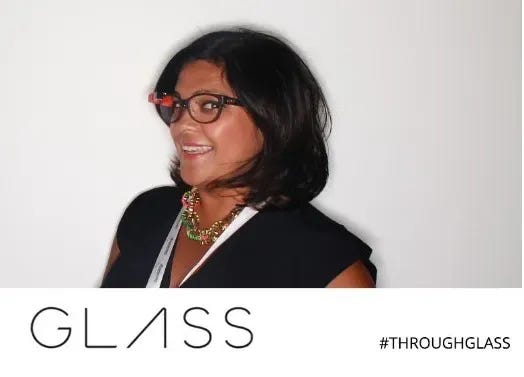
Twelve years ago I helped promote the first pair of these - Google Glass. My job that day was to tell you how beautiful they were.
So. Pervy or practical?
“You did look like a twat”
The technology was never the thing standing in the way. Nobody wanted them on their face
.
I wore them myself, briefly. You did look like a twat. I certainly felt like one, standing there tapping my own temple like a woman trying to remember where she’d left the car. This was years before it was normal to walk down Oxford Street talking to yourself, and in any case you didn’t talk to them. You tapped.
Back in the office we teased each other rotten. There were people who genuinely loved wearing them, people who felt the glasses made them look clever. They did not. We had a word for those people and we never once said it to a customer’s face.
Glass wanker.
“What are they for?”
Glass didn’t die of ugliness. That’s the comfortable story, because ugliness is fixable and we love a fixable problem. We put a fashion house on it. It didn’t help. The question that killed it was shorter and much worse.
What are they for?
Nobody could answer it. Not one person on this earth stood in their kitchen thinking, if only this were on my face. When Google pulled them, none of us were surprised and a few were relieved.
They never actually stopped, though. Glass carried on where it turned out to be unarguably brilliant. Surgeons with the scan in their eyeline instead of on a monitor behind them. Factory lines with the spec floating over the part. Accessibility, the use case I will defend in any room you put me in.
Every single person in those rooms had agreed to be there.
Glass shipped in April 2013. More than thirteen years ago. You would assume a comeback on that timeline means the objections got answered.
Plenty did. The chips are smaller, the capability isn’t comparable, and there are real fashion names on the frames now rather than a collaboration bolted on as an apology. I’m not sniffy about engineering wins. I watched people work themselves into the ground for those.
The question of social responsibility hasn’t moved a syllable.
“Wouldn’t it be great if”
Back in 2014, in a room in London, we were doing the thing you do with a new bit of kit. Listing what it might be for. I offered mine up.
Wouldn’t it be great, I said, if you looked at somebody and their information popped up. Their name. Their LinkedIn profile. Something that told you how you knew them.
Anyone who has stood at a drinks thing beaming at a face they cannot place knows exactly what I was reaching for.
The words were barely out of my mouth.
Oh no. That is a terrible idea. You would be pulling up a stranger’s life without them knowing a thing about it, and standing right there I could see every way somebody could turn that on a person.
I said so, out loud. Nobody prompted me. It took about a second.
Having the thought is ordinary. The catching is the rare bit.
The rooms where these things get designed, marketed and signed off do not have anywhere near enough of it.
“Designed for everyone”
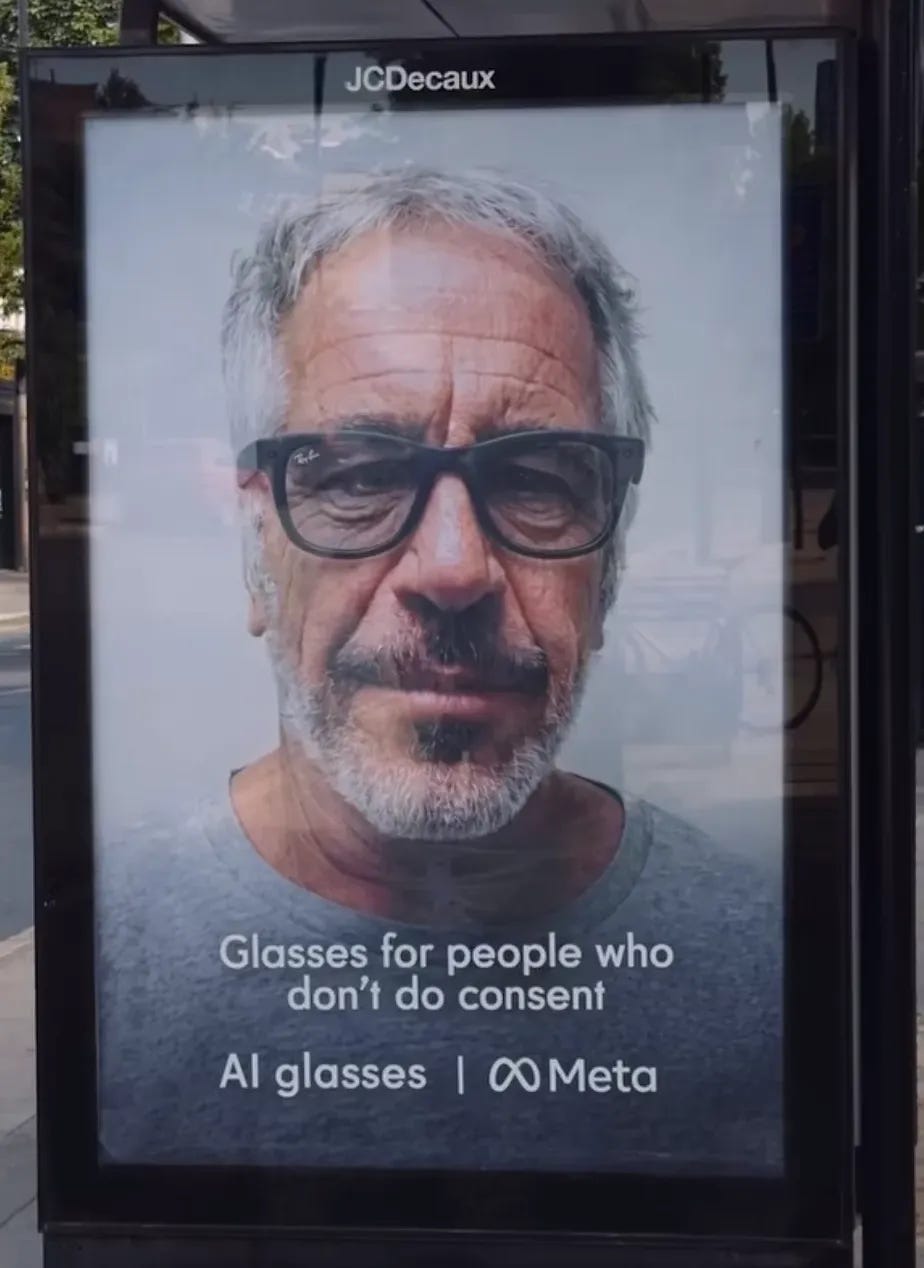
Meta’s pair picked up a lot of coverage during the 2026 launch cycle - a lot of it they wish they hadn’t. They also quickly got named ‘Pervert Glasses’ - I doubt that was in the launch plans.
When the company’s founder (Zuckerberg) built FaceMash in October 2003 Harvard shut it down within days and hauled him before its Administrative Board, charged with breaching security, violating copyright and violating individual privacy. He wasn’t expelled. What else, if anything, they did to him has never been made public. His own line at the time: issues about violating people’s privacy don’t seem to be surmountable. I’m not willing to risk insulting anyone.
Twenty-three years on. This summer Meta pushed a mandatory update that permanently kills the camera on any pair where the recording light has been drilled out, after a hobbyist worked out how to desolder it for sixty dollars. Thousands of pairs, bricked. Meta says under 0.1%, a figure picked to sound small and landing, on a user base that size, as anything but. Their VP of AR called it a bit of a cat-and-mouse game.
In the same window, Meta bought billboards. “Designed for everyone, not just the people wearing them,” they read. Underneath: “The camera lets you capture the moment. The light lets everyone around you know when you do.”
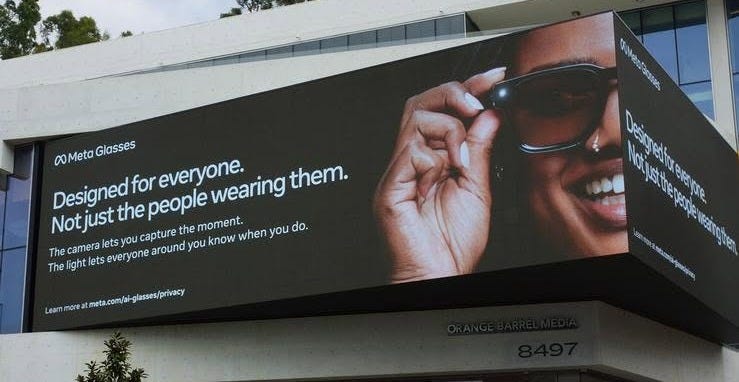
The light they were, at that precise moment, watching people drill out.
In late August, Futurism went looking at American schools and found the pattern you’d predict and still hope not to find. Videos taken almost always on Meta’s Ray-Ban AI glasses, posted straight to TikTok and Instagram. Every clip was filmed by a teenage boy, and the behaviour was overwhelmingly aimed at girls. One account had over sixty thousand followers and dozens of videos of girls asking to be left alone.
When people started casting about for a way to defend themselves against a stranger filming them, the best idea the internet came up with was to play Disney music at them. The theory being that a corporation’s copyright gets enforced faster than a person’s face.
It doesn’t work. Enforcement sits with the platforms, not the hardware, and most of that footage lands on Instagram, which is to say on Meta. An attorney called Gene Kang put it to Fortune plainly: if you’re the person being recorded, you don’t own any copyright to the composition.
You own nothing. Mickey Mouse owns something.
That’s the whole architecture in one sentence, and nobody sat down and designed it that way, which is worse.
“Not for recording your lunch”
In June a Chinese startup called Monako launched a pair of smart glasses at $399. Forty-eight grams, its own Linux build, aimed at developers, AI users and researchers. They run Claude Code and Codex. You describe a task out loud, an agent starts building it, and you pin the result to your glasses.
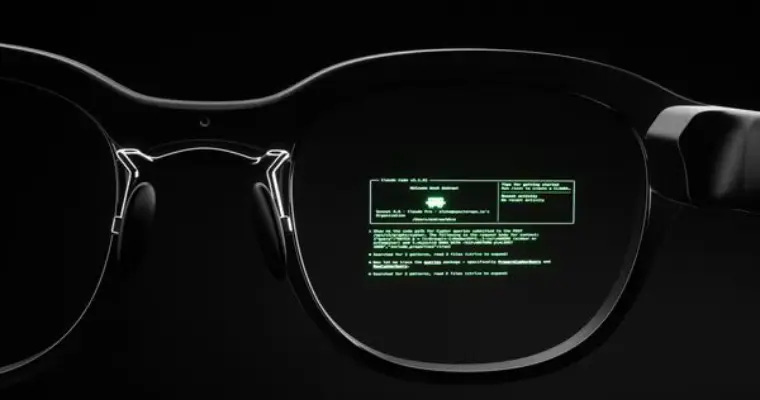
Their own marketing line: “Monako Glass isn’t for recording your lunch; it’s for building your next project.”
Marketed explicitly against recording. Priced for a graduate. Built by a small team who meant every word of it.
It has a camera on it.
What stops them being used in pervy ways? Nothing does. It took me a fortnight to see what that means. This isn’t a Meta problem, or a Zuckerberg problem, or a price problem. A team with entirely different intentions built the identical hole.
Who was in the room
Which leaves one place left to look, and it sits upstream of the marketing, the frames and the regulator. The table. The moment somebody said, and it should take pictures.
Who was sitting there?
This is the heart of it for me, and it’s the argument I make about AI everywhere else.
You need women at the point of inception, through design, through marketing, all the way through to regulation. When we’re absent, this is exactly what gets pushed through without consideration. Not maliciously. Just without anyone in the room flinching.
Before anybody reaches for the men-are-bad reading, that isn’t the argument, and I’m the proof of it. The idea in 2014 was mine. A woman with entirely decent intentions reached straight for the same hole every designer since has reached for. The difference was that I heard what was wrong with it, and I heard it within a second.
A room notices what its people have had to think about.
A room where nobody has spent a lifetime being looked at will not think about being looked at. That is a fact about how specification meetings work, not a moral judgement about men.
My honest test: how fast do you reckon privacy regulation would arrive if the main use of these glasses turned out to be women wearing them to assess men, in every respect?
I think we’d have a directive by Friday.
There’s something that room didn’t know to ask about, and I’ll keep it short.
In March, CNN published a months-long investigation into an international network of men sharing techniques for drugging and assaulting women. Photographs of their wives, traded without their knowledge. Methods, traded. On an ordinary pornographic site hosting more than 20,000 videos tagged as sleep content, which drew around 62 million visits in February alone. Visits to the site as a whole, that figure, not to that material, and not a count of men. Nobody has one.
That’s the world these glasses are launching into. When somebody tells me a hands-free camera on a stranger’s face is neutral hardware, I’d like to know why we think this won’t be part of it.
Beautiful photography is not a privacy policy
The advertising, then. I say this as a woman who spent thirty years making it.
Snap’s Specs are $2,195, shot by Steven Meisel in glorious black and white, with Kaia Gerber, Jack Harlow, HoYeon Jung, Jimmy Butler and Imogen Heap. Beautifully done, cleverly cast, and a hard brief: they’re big, they’re chunky, and two grand buys you what, exactly, that a cheaper pair doesn’t?
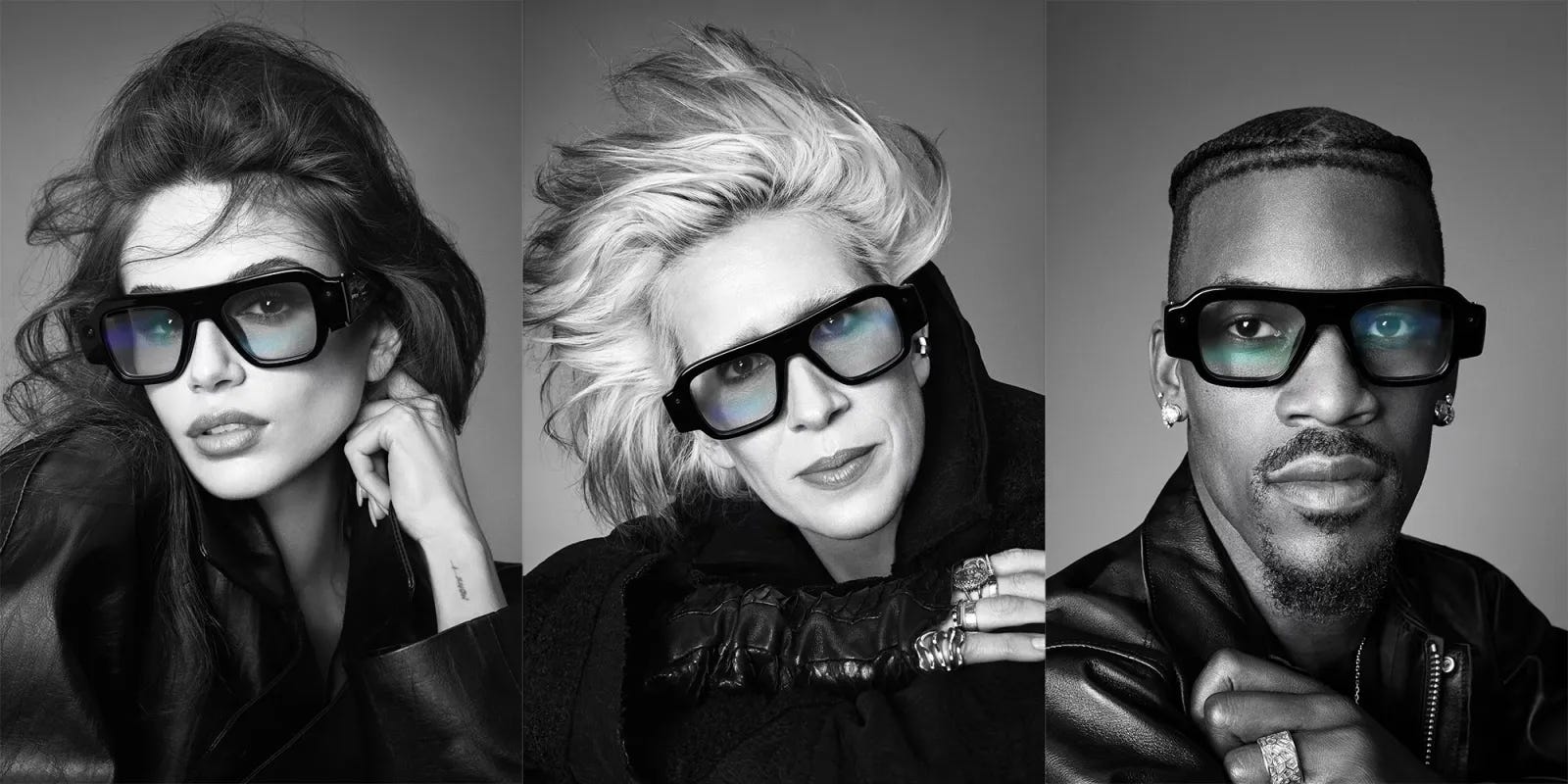
What it buys is a tier. An elitist one. Snap’s core audience will never get near that price, and the people modelling them have never had to worry about a stranger filming them, because being looked at is the job.
Ten years at Google taught me the campaign is always ready long before the answer is.
Kevin Hart films a stag do
Popular culture got here before the regulators did, which is usually a sign.
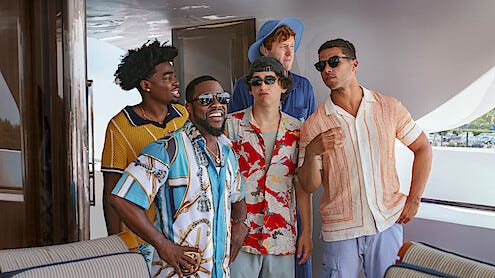
In 72 Hours, the Kevin Hart film Netflix put out this summer, he plays an ad man who blags his way into a stranger’s stag do in Miami and secretly films the lot of them as market research for a vodka campaign. Meta glasses, named on screen.
It works. It gets him exactly what he needs, and it’s very funny to watch.
Then he’s caught. The group turns on him and the whole thing comes apart, and it’s the filming that does it. He never asked them.
That’s the plot. A summer comedy about a stag do built its third act on the asking.
Tim Cook doesn’t give a rat’s
Google goes this autumn, and at I/O this year it split the category in two. Audio glasses that offer spoken help in your ear. Display glasses that show you the information you need, right when you need it. Audio ships first. Display comes later.
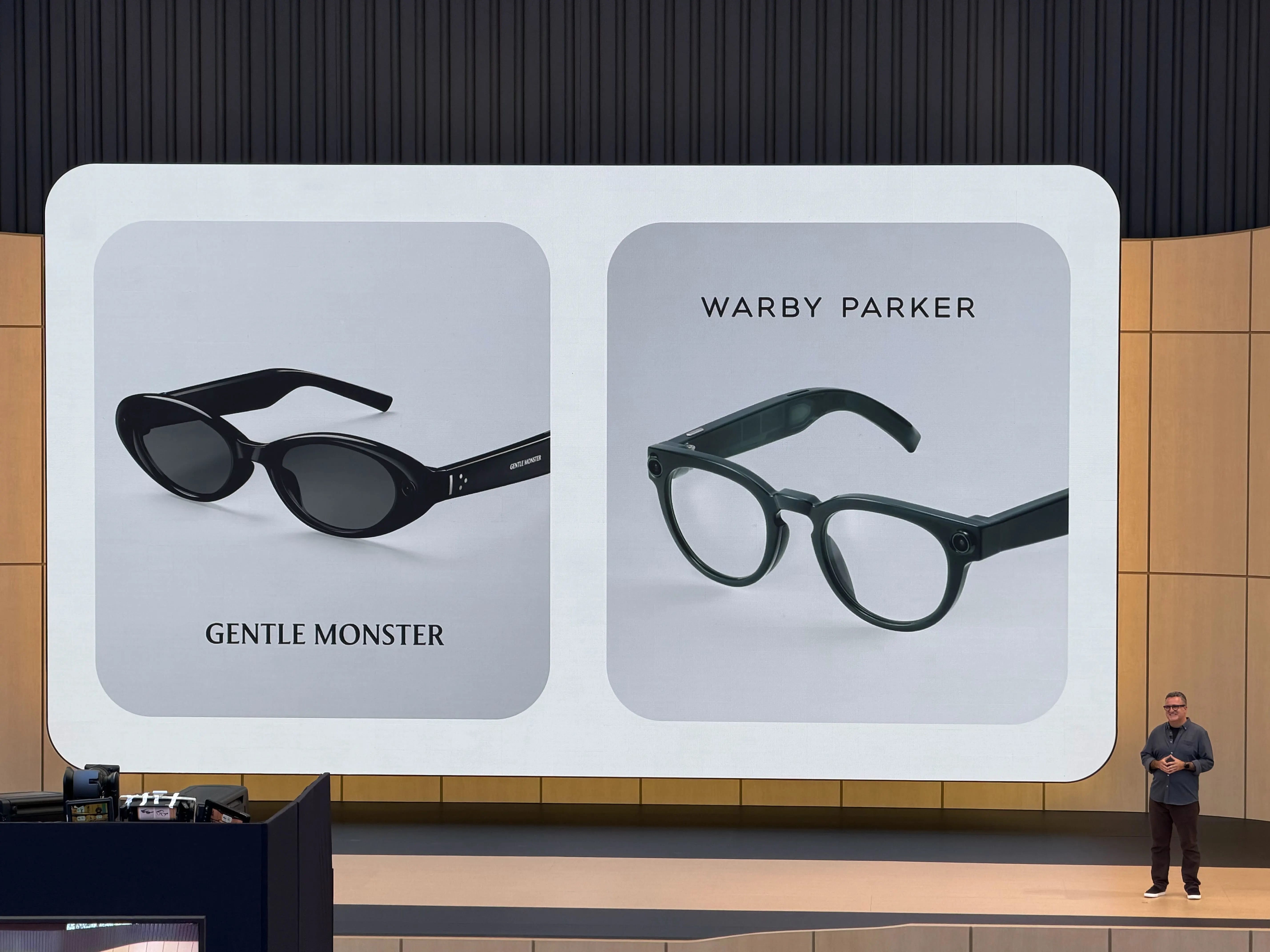
Read that running order as an answer. The unsolved part isn’t the waveguide.
Apple is rumoured for the very end of 2027, according to Mark Gurman at Bloomberg, held back until Siri can carry the visual intelligence. Tim Cook saw it coming in 2017. He told the Independent the technology itself didn’t exist to do it in a quality way, then added the most Apple sentence ever constructed. “We don’t give a rat’s about being first, we want to be the best.” Cook, nine years ago, about a product Apple still hasn’t shipped.
The analysts are calling it the next Apple Watch. Apple was late to smartwatches by the better part of a year and defined the category anyway.
This is the part I genuinely can’t call. When those two make these mainstream, and they will, adoption itself moves the privacy conversation. Enough people wearing them could normalise it until asking feels rude. Or enough people could end up on the wrong end of a lens that the demand for rules finally gets loud enough to matter.
I’ve been wrong about which way that goes before.
Three words
I’m not going to wear them. Partly because I can’t see what I’d get that’s worth the trade. Mostly because of the people who never got asked, and standing with them costs me nothing.
On privacy, I don’t think we’ve made peace with anything. We’ve got a better sense of what we’ll hand over and what we want back for it. What we haven’t got is any answer to what we can’t see and can’t control, or an explanation of why, after all this time, it still isn’t a switch you can turn off.
Twelve years ago I stood next to a display case in London and told people how beautiful they were.
So, the small thing. If someone you’re talking to is wearing a pair, ask.
Are you filming?
Three words, no confrontation, and it does two jobs at once. You find out, and they remember that someone can tell. Not everyone understands this technology yet. The people who do can help the rest, and that is roughly all accountability looks like before the law turns up.
And then tell me what I’m missing, because I might be. Is there something obvious here, some benefit I can’t see, that makes all of this worth it?
Nish x
I’m Nishma, and I help people get Switched ON to AI. Less overwhelm, more time and freedom, and a brand that stays unmistakably yours. If you’re midlife, brilliant, and tired of being told you’ve missed it, you’re exactly who I do this for. Come and find out more at nishma.co.
Very interesting. I suspect the answer to your final question is no!