


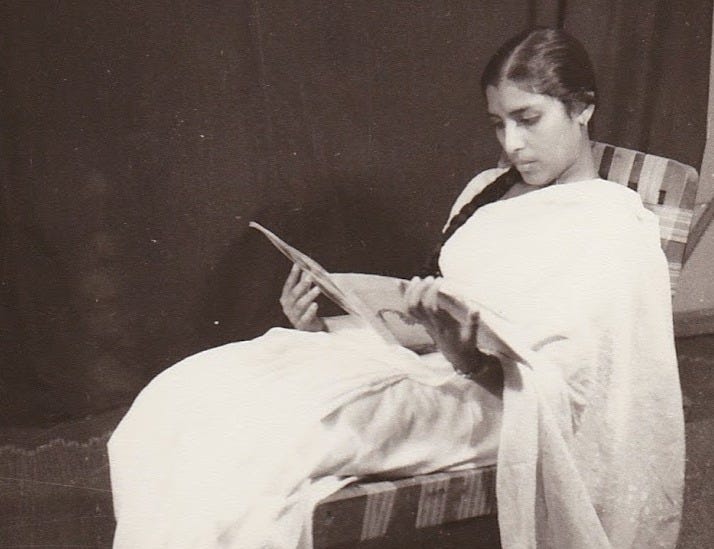
She spent her last money on a coat. Not for herself.
It was a cold winter. She had just arrived in the UK, alone, in her mid-twenties, wearing a sari and sandals. Not an overcoat between her and an English January. She had a little girl with her, barely three years old. She had a handful of contacts, not much money, and not the warmest of receptions in 1960s Britain.
The Daily Mail will not write this story.
Reform do not want you to hear it. Suella Braverman has built an entire career on making sure people like my parents are seen as a problem to be solved rather than a story worth telling.
They are wrong. They have always been wrong.
My mum arrived in this country alone, in her mid-twenties, in a sari and sandals in January, with a toddler and not enough money for a coat. She spent what she had on my sister. Then she got on with building a life.
She had money enough for one coat. She spent it on her daughter.
Then she waited. She did not complain. She got on with it.
That is Indira. That is my mum.
This is a story about my mum. But I suspect it might remind you of yours.
The women who came before us - mums, grandmothers, aunties, neighbours - who carried the whole world in one hand while making dinner with the other.
No profile piece.
No personal brand.
No five-year plan.
Just quiet, relentless brilliance that nobody stopped to name.
This is one of those stories.
Born to Move
My mum was born in Jamnagar, Gujarat, and grew up in Nairobi, Kenya, where she went to school. She was the youngest of four children, creative and curious from the start. She came back to India for university, studying Fine Art at the University of Baroda, which is also where she met my dad, Vipin.
Her first act of rebellion came before she ever boarded a plane. She was a Shah. My dad was a Patel. In the Gujarat of that era, that was not how things were supposed to go. She did it anyway. Sixty years of marriage later, I think we can agree she called that one right.
She was also, by this point, a trained Montessori teacher, a gifted artist, and a sitar player. Elegant, warm, deeply funny, and, if the family stories are anything to go by, already completely ungovernable in the best possible way.
She did not yet know she was about to spend the rest of her life starting over. She and my dad both. Together.
The Woman Who Came First
The plan was for my dad to come to the UK first. Immigration had other ideas. My mum, who held a British passport from her Kenyan schooling and spoke excellent English, ended up going ahead. Alone. With a toddler. Into a country she had never set foot in before, at a time when being a young South Asian woman on a London street was, to put it gently, a fairly terrifying reality.
She found her feet. She always did. She navigated the London transport system on her own, making relentless trips to the Home Office to fight for my dad to be allowed to join her. She set up a life from nothing. She waited, she campaigned, she managed, she held everything together.
When my dad finally arrived, one of her earliest memories of the two of them being together in this country was the summer of 1969. They were living in a shared house, and she remembers being huddled around the television with the other residents watching the moon landing. The whole world holding its breath at the same moment. A young Indian couple in a shared house in England, watching humans walk on the moon. There is something about that image I find quietly extraordinary.
In a country that was not always kind to people who looked like them, there were people who were. A family friend who would look after my eldest sister on the nights my mum had to go and do her shift at Sainsbury’s. That mattered. It still does.
They built something together from there. Finchley first, then Watford. Three daughters. A house that was always, whatever else was happening, full of warmth.
The sitar music was constant. So was the smell of her cooking. If you closed your eyes, you could almost forget how hard it all was.
The Woman Who Never Stopped
My childhood memories of my mum are sensory ones. Holding her hand on the walk into Watford town centre. The sound of the sitar drifting through the house. The smell of food that made the whole street quietly curious about what was happening in our kitchen.
She was soft and calm and elegant. She was also, underneath all of that, made of something very few people are made of.
She ran a grocery shop alongside my dad. She worked evenings. She raised three daughters. She did it all simultaneously, without fuss, without complaint, and with the kind of warmth that made everyone who came near her feel looked after. Stray dogs found their way to our door. Stray cats. The occasional pigeon. She fed everyone. She simply could not bear to see anyone go hungry.
Human or otherwise.
Another Country, Another Chapter
When I was fifteen, my parents made a decision together that took extraordinary courage. They left for the Canary Islands to start again. New country. New language. New life, from scratch, in their mid-forties.
Neither of them had run a restaurant. Neither had any real idea of the trade. What they had was each other, a refusal to be defeated, and my mum’s completely inexplicable ability to create food that made people want to come back.
She had never eaten meat. She learned to cook it. She taught herself Spanish. She designed menus from nothing. She and my dad built an Indian restaurant called Natraj that people still talk about. The food was award-winning. People came back again and again. And the cooking was done by a woman who navigated every dish entirely through smell, texture, and instinct, without a recipe book in sight.
I was a vegetarian for the first eighteen years of my life. Then I tried her butter chicken. That was that.
They were in the Canary Islands for nearly twenty years. There were highs and lows, as there always are when you build something from nothing in a foreign country. Each time something fell apart, they picked themselves up. Together. Not with bitterness or resentment. With grace, with humour, and with an optimism that, frankly, should have run out years before, but never did.
Sixty-plus years of marriage. Multiple countries. Multiple reinventions. Through all of it, the two of them. Still standing. Still going.
The Woman Who Came Home
When my parents came back to the UK, I was thirty-five. My mum was sixty-five. I was beside myself with happiness. I had missed her every day she was gone, and I did not fully understand until she was back how much I had needed her near.
Not long after, I had the twins. And whatever I have managed to be as a mother is entirely because she was there. Her, my sisters Shilpa and Shalini, my dad. My children are who they are because of all of them. I will not be taking sole credit.
Retirement was not really on the agenda. She adjusted to being back in Britain, to a world that had moved on considerably, and she did what she always does: she figured it out. My dad, who had always been quietly brilliant with technology, helped. Between the two of them they were going to get there one way or another.
She skipped email entirely. Went straight to YouTube. It became her window to cooking programmes, music, remedies, culture, stories. A lifeline that kept her connected and curious when the world might otherwise have been inclined to overlook her.
These days it is AI that has caught her attention. She is marvelling at it. Asking questions about it. Slightly baffled by all of us and how fast we are moving, she would quite like us to slow down, but she is watching and learning and forming opinions. She always is.
She is in her early eighties. Still watching. Still cooking. Still curious. Still giving. Still cheeky.
What She Taught Me Without Knowing It
My mum never had a LinkedIn profile. She never gave a TED talk. She never won a business award, though by rights she should have won several. No title. No corner office. No profile piece in a trade magazine.
She was a pioneer anyway.
She built businesses across three countries in two languages she taught herself. She raised three daughters who went on to build careers and families she is, I hope, proud of. She cooked for anyone who was hungry. She took in every stray that wandered past. She played the sitar. She painted. She taught children. She reinvented herself more times than I can count, each time with zero drama and maximum dignity.
And she did all of it alongside my dad, in a partnership that has lasted over sixty years, across every imaginable kind of difficulty, and is still going.
She has a line she has said to me my whole life. Quietly. Without ceremony.
You are judged each time you put your head on your pillow. Make sure you have earned your rest.
I have never forgotten it. I probably do not live up to it as often as I should. But it is with me every single day.
Not All Unmissable Women Look the Same
I am building a business around the idea that invisible women do not get paid. That visibility is not vanity, it is survival. That you cannot change a room you are not in.
But the woman who taught me that was never invisible by choice. She was brilliant and talented and curious and wildly capable, and the world was simply too slow, too narrow, too easily distracted to see it.
That was the world’s loss. Not hers.
Here is what I want you to take from this, if you are reading it today.
Not all boss women look the same. Not all pioneers, mavericks, absolutely badass women come with the titles to prove it. Some of them arrive in this country in a sari and sandals with a toddler on their hip and figure it out anyway. Some of them learn to cook meat they have never eaten in a country where they do not yet speak the language and win awards for it. Some of them hold a marriage together for sixty years and a family together across continents and still find the energy to be curious about artificial intelligence at eighty-something.
We do not celebrate these women enough. We do not pause long enough to look. To listen. To say: I see you. What you did was extraordinary.
The optimism. The kindness. The quiet refusal to be beaten. That is not soft. That is the most powerful fuel there is. And most of us inherited it. We just forget to name it.
I am fearless because of immigrants. My immigrant parents.
I am determined because of immigrants.
Whatever I have contributed to this country, and I intend to contribute a great deal more, exists because two people from Gujarat had the courage to get on a plane and start again.
The stories that ignorance and cruelty want to erase are the stories that built this place.
Today I am choosing humanity and curiosity over the noise.
To my mum, who is everything.
To my dad, who has been by her side for every chapter of it.
To my sisters, Shilpa and Shalini, who shaped me as much as anyone.
To the grandchildren who are lucky enough to call her Nani.
And to every woman reading this who sees her own mum, her own grandmother, her own quietly extraordinary someone in these words:
Happy Mother’s Day.
They were never invisible. They were just waiting for us to catch up.
Nishma x
Reading this reminded me of stories my Mum tells me about first coming to England. So many familar things, and sadly a generation of invisible women that only we know about, which I know for them is enough