


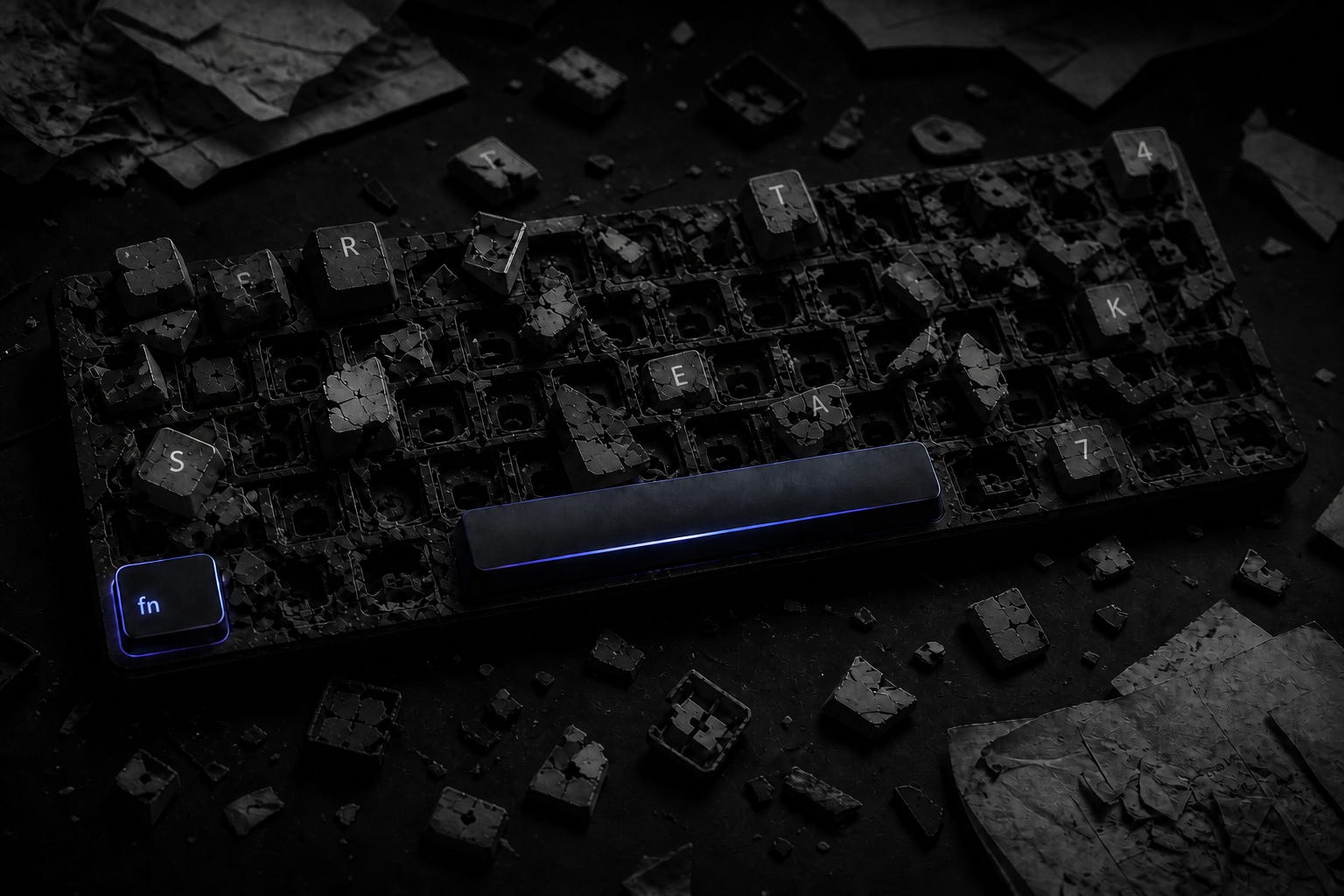
My keyboard and I are taking a break.
It’s not you, keys.
It’s me.
Mostly because my hand stopped cooperating.
I don’t write for a living. I communicate for one.
I think in writing, definitely. Which means I spend a slightly alarming amount of time at a screen, with my fingers doing the heavy lifting and my eyes quietly filing a formal complaint (2nd cataract op on its way and no, I’m not that old!).
Then I developed RSI.
Typing became painful. Not dramatically cinematic pain. Just the sort that creeps into everything and makes you realise how much of your working life depends on repeatedly moving the same tiny collection of muscles.
That’s how I found Wispr Flow.
I wasn’t looking for the next shiny AI toy. I needed to solve a real problem.
Which is often when technology is at its best.
Now I dictate walking the dog.
In the kitchen, with both hands in a bowl of something.
Moving around the house.
At one in the morning, whispering, because I’m still working and I don’t want to wake anyone.
I send longer WhatsApps than anyone asked for. I have probably dictated several Substack essays into people’s inboxes by accident.
Sorry.
And with its ‘Notetaker’ my meetings don’t evaporate any more either. It listens, I talk, the notes land in Claude, and an agent I trained turns them into the actions I used to lose somewhere between the tube and the front door.
But the thing I love most is not the speed.
It’s that I can get the thought out before I’ve edited it to death.
I can talk in a messy stream of consciousness, correct myself halfway through a sentence, change direction, have a little moan, and then look at what I actually meant.
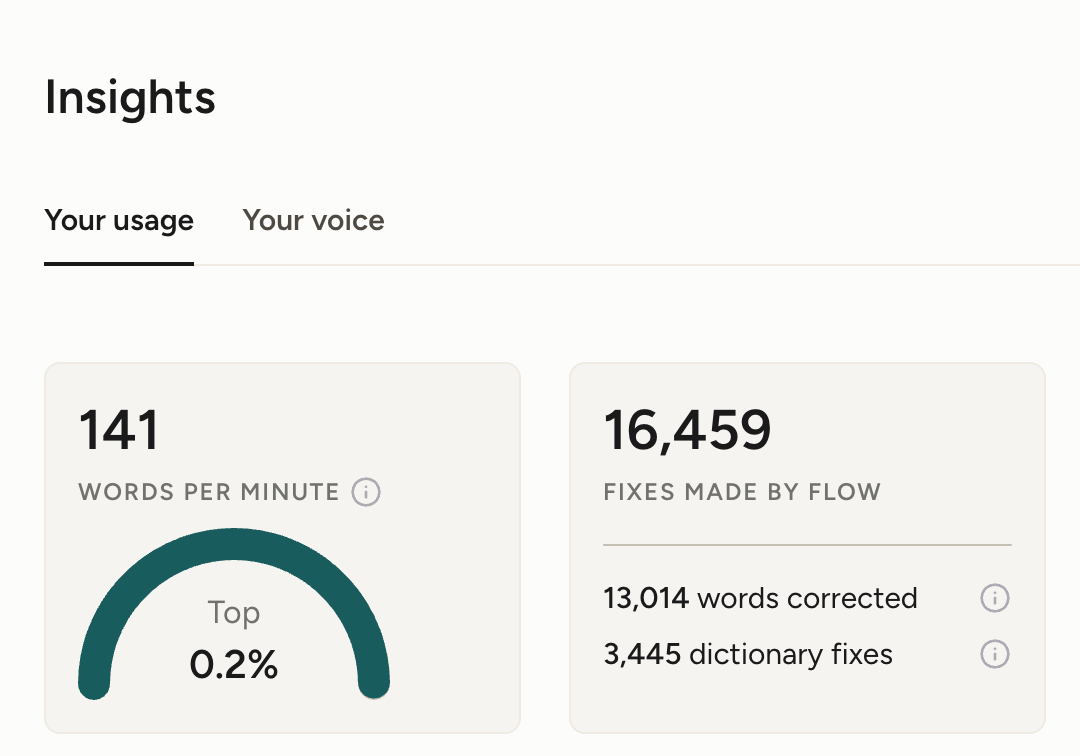
My process now:
AI at the beginning.
My thinking in the middle.
AI at the end.
That middle bit matters.
It’s still me thinking. Me making the connection. Me having the idea. The technology just gives it somewhere to go without demanding a polished first draft out of aching hands.
I’d go further than I used to.
I think talking is the only way to get the best out of AI.
Typing is editing. You can’t type a sentence without half of you tidying it as it goes, picking the respectable word over the true one. By the third line you’re performing.
Which means what you get back is capped by how much of your real thinking you were willing to hand over.
Typing quietly withholds most of it.
Nobody types a moan.
“I already talk to my AI,” people say. They’ve got the voice thing, they press the button.
It isn’t the same, and the difference is all in the engineering.
Wispr clears the wreckage out of speech while you’re still making it. The ums. The ahs. The “no, hang on, not that”. It handles the mid-sentence correction, which I do constantly, without sending me back to clear up after myself.
It copes with accents it wasn’t raised on. With dialects. With mumbling. With a woman whispering at her laptop in the dark.
The gap between a voice button and this is the gap between being recorded and being understood.
And this is where so many conversations about AI stay weirdly narrow.
The use cases are presented as though this is mainly for young tech-bro entrepreneurs building a company before breakfast.
Fine.
But some of the most important ones are far less shiny.
Parents with a baby in one hand and a business in the other.
People with cerebral palsy, or anything else that affects fine motor control.
People whose speech doesn’t fit the assumptions built into traditional voice tools.
People recovering from repetitive strain.
People who have ideas, stories and work to share, but for whom a keyboard is difficult, painful, or simply a locked door.
A friend told me about her son a few weeks ago.
He has cerebral palsy. Fine motor control is the thing it takes from him, so typing was never really on offer.
He’s been working with Wispr Flow.
He writes now. He tells stories. He sends his work the way everyone else sends theirs.
She mentioned it in passing, the way you mention a good week.
I’ve thought about very little else since.
I often think about what this could have meant when I had my twins.
The hours and hours awake in the middle of the night, feeding babies, trying not to fall asleep sitting up, discovering that 3.17am gives you an extraordinary amount of time to think.
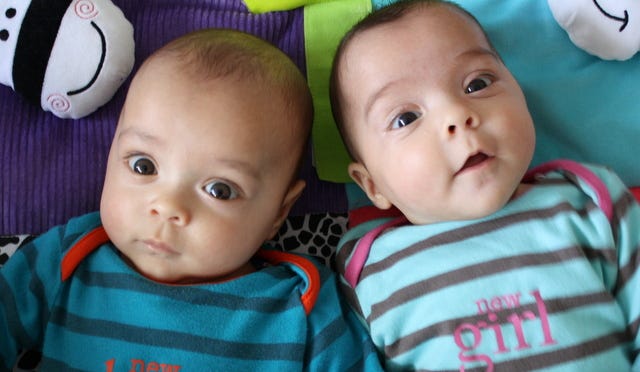
If I’d had something like this then, perhaps I could have got some of those thoughts out.
Not because parents need another way to be productive at three in the morning.
Because having another way to communicate changes what is possible.
That’s the bit I wish we talked about more.
Technology at its best is NOT always about doing more.
Sometimes it’s about making something possible for someone the design was quietly locking out.
So I’m delighted that Wispr has just raised $280 million at a $2 billion valuation.
Delighted is not a word I trot out about funding rounds.
Money like that means they keep building, and I hope they spend it making this work for more people, in more places, across more accents, speech patterns, bodies and lives.
The world does not need more tools designed around one narrow idea of a “typical” user.
Congratulations to the team.
You’ve solved a very real problem for me.
Now please go and solve it for ten times as many people.
And if the alternative is another billionaire building a bigger rocket for reasons best discussed with a therapist, I know where I’d rather see the money go.
Nish x
I’m Nishma, and I help people get Switched ON to AI. Less overwhelm, more time and freedom, and a brand that stays unmistakably yours. If you’re midlife, brilliant, and tired of being told you’ve missed it, you’re exactly who I do this for. Come and find out more at nishma.co.