


“Right, quiet now. Nishma, that means you.” I heard that line roughly nine thousand times before the age of eleven. Every school report carried the same verdict in the same tired teacher biro: a pleasure to have in class, if only she’d stop talking.
‘She’ did not stop.
Ask any of my friends. I am famous, genuinely famous, for the long story. For the WhatsApp voice note that lands like a surprise feature-length podcast, complete with tangents, a full cast of characters and a dramatic pause nobody asked for. I have never once used ten words where four hundred would do. And for thirty years, that was the thing about me people learned to tolerate. Fondly, mostly. But tolerate.
Then something funny happened. The exact trait I was told to rein in became the most useful skill I own. Turns out the age of working with AI belongs to the talkers. Funny how it goes.
Everyone is typing at their AI like it owes them money
Short. Clipped. “Write a follow-up email.” “Make it shorter.” “More professional.” We treat the most capable thinking partner most of us have ever had like a moody vending machine. Coin in, snack out, thump it when it jams.
I did this for months. Then my wrists staged a quiet protest, I found a tool that types while I talk, and I stopped typing at my AI. Now I just talk to it. Same AI. Same me. The answers got better overnight. The only thing that changed was that I opened my mouth.
But the AI part is only half of it. Because I don’t just talk to brief the machine. I talk to catch my own brain before it wanders off.
My best ideas never arrive at my desk
They arrive on a dog walk. Milly’s nose is in a hedge, I’m three fields from a keyboard, and the whole shape of a talk or an essay lands in one go, fully formed, glorious, and gone in ninety seconds if I don’t grab it.
So now I grab it. Out loud, into my phone, mid-walk. The newsletter intro. The reply I’ve been dodging for a week. The story I want to tell on stage. The message to a friend that would otherwise have died in my drafts. All of it, spoken while it’s still hot, before the moment cools and I lose the good bit.
This isn’t a dictation trick for people too lazy to type. It’s a net for the ideas that used to get away. The ones that came at the wrong time, in the wrong place, with both hands full of dog lead.
Typing is performance. Talking is thinking.
There’s a reason talking catches what typing kills.
When you type, you edit. You can’t help it. The cursor blinks and some prim little sub-editor wakes up in your head and starts tidying before a single word reaches the page. You delete the messy bit. You cut the story. You trim the context to something that looks efficient and reads like a memo. By the time you hit enter, you’ve handed over a headline and binned the article.
When you talk, the sub-editor goes for a lie-down. You ramble. You backtrack. You say “oh, and the important bit is” halfway through a sentence, the way you would to a friend leaning on your kitchen counter. You give it the texture. The truth. The stuff that makes it sound like you, because it came out of you, out loud, before your inner critic could find her red pen.
A word for the grammar police, with love
I know it’s a touch blasphemous to sit here on Substack, of all places, and make the case for talking over writing. This is the church of the sentence. But I’ve never had much time for the snobbery of it. The dictionary police. The grammar prefects who treat a stray comma like a moral failing.
And let me be clear, because otherwise they’ll come for me: my spelling and grammar are A-plus. I know the rules cold. I just also know they were never the point. I have always, always been better yapping than typing.
My wonderful old colleague Charlotte worked this out long before any app did. For years her note to me was “get those digits on the keyboard, Nishma.” Firm. Loving. Completely ignored. Until one day she gave up, handed me a dictaphone and said, more or less, just talk, I’ll sort the rest. The Wispr Flow before the Wispr Flow. Charlotte, if you’re reading this, you were a decade early and I owe you a very long voice note.
It’s a dictaphone with a brain
That’s the bit that makes the tool more than a party trick. It’s an intelligent one.
It doesn’t just transcribe my mess, ums and false starts and all. It tidies the thinking as I talk. It knows the words I actually use, because I’ve trained it on them: the phrases I reach for, the places I want to sound casual, the places I want to sound like I’ve read the room. It loses the stumbles without losing me. And that is the whole game. A lesser tool would sand me down until I sounded like everyone else. This one keeps the grit and only takes the gravel.
So the story comes out first as a conversation. Warm, rambling, mine. And then, only then, do I edit. That’s when the red pen comes out, and I edit like Anna Wintour got hold of it. Ruthless. Cold. Cut, cut, keep, cut. Because you cannot edit a blank page, and you certainly cannot edit fear. But you can edit a ramble. A ramble is a gift. It’s raw material with a pulse.
The chatterbox was right all along
We got this one wrong.
The whole industry taught us to “prompt”. To engineer the perfect string of instructions, as if we were programming a microwave. There are courses. There are enormous decks. There are men on LinkedIn selling “the only 12 prompts you’ll ever need” for £39, cash upfront. And every bit of it points the wrong way. Briefing an AI was never a coding problem. It’s a conversation problem. And the best brief has never been the shortest, tidiest one. It’s the one where you actually explained what you wanted and why, tangents and worries and all.
Who is world-class at that? The talkers. The over-explainers. The ones who give “too much detail” in meetings and send the feature-length voice note. Every trait the office quietly filed under “a bit much” is now, out of nowhere, an advantage. The chatterbox spent thirty years being told to get to the point. Turns out the detail was the point.
So. What to actually do.
Stop typing at your AI. Talk to it. Get a tool that turns your voice into text (I use Wispr Flow, and my wrists have sent it a thank-you card) and brief it like you’d brief a clever friend who genuinely wants the context. Claude, mostly, in my case. Then use it for everything else too. The walk-idea. The dodged email. The message you keep rewriting into beige. Catch the thought where it lands, not where the keyboard happens to be.
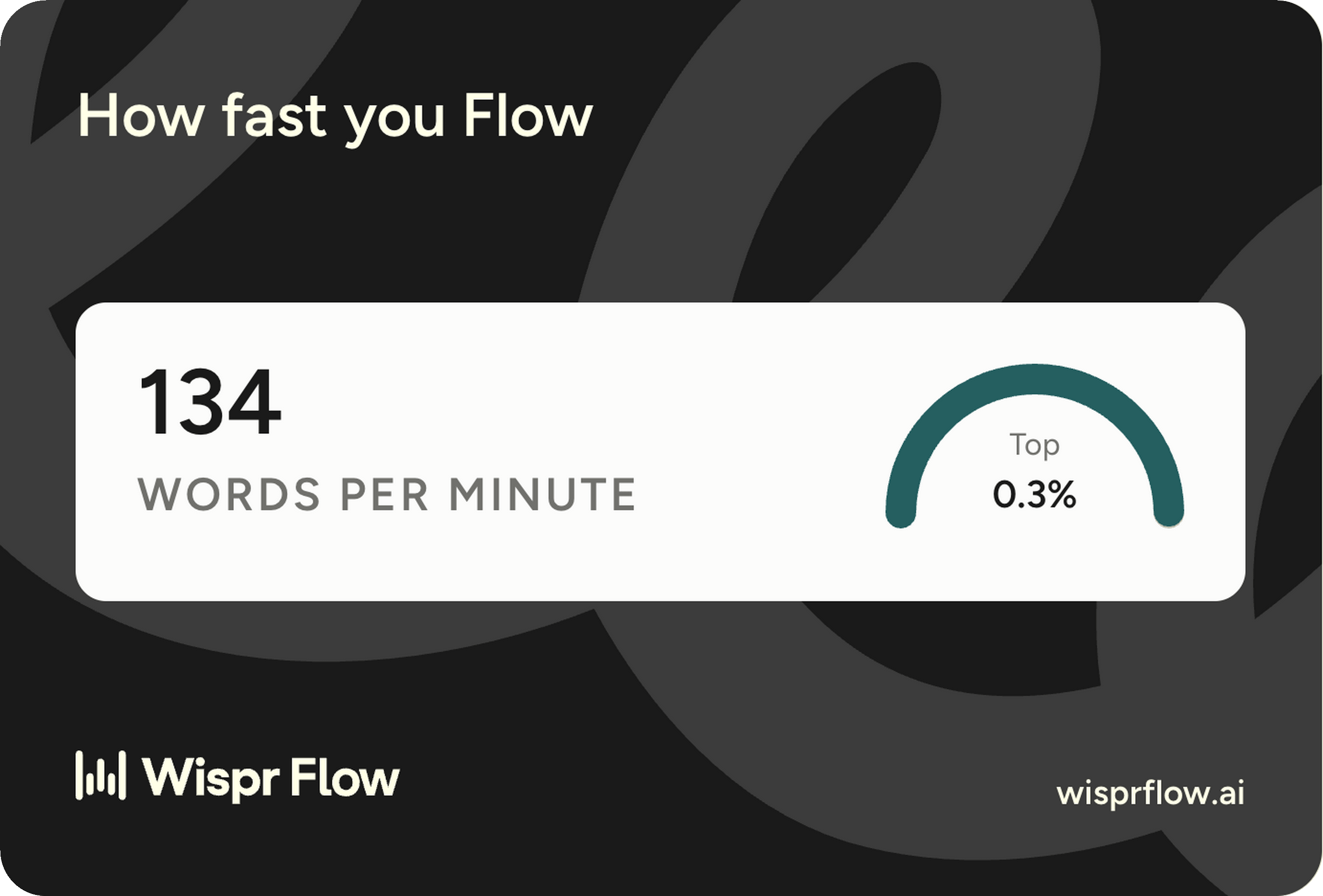
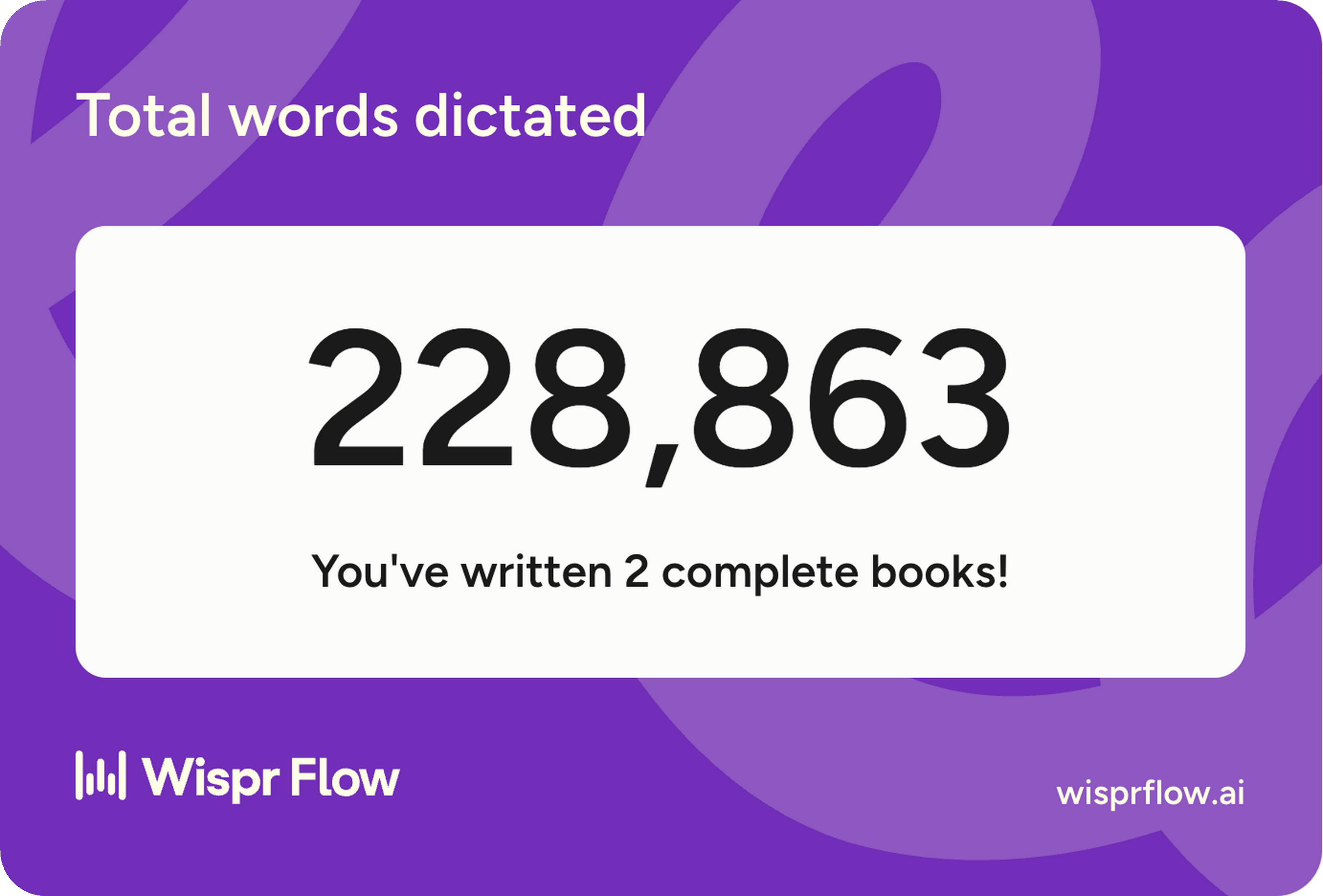
These are my stats …
And if you catch yourself editing before you’ve even spoken, that’s the old teacher in your head. Ignore her. Talk first. Edit later, as savagely as you like.
And the bit that still makes me laugh: I love writing more now than I ever have. More essays, more posts, more of this. Not despite the talking. Because of it. AI didn’t replace the writer in me. It has quietly opened up a hundred doors that felt shut before, and it finally let her out of the room where the keyboard was keeping her quiet.
Go figure.
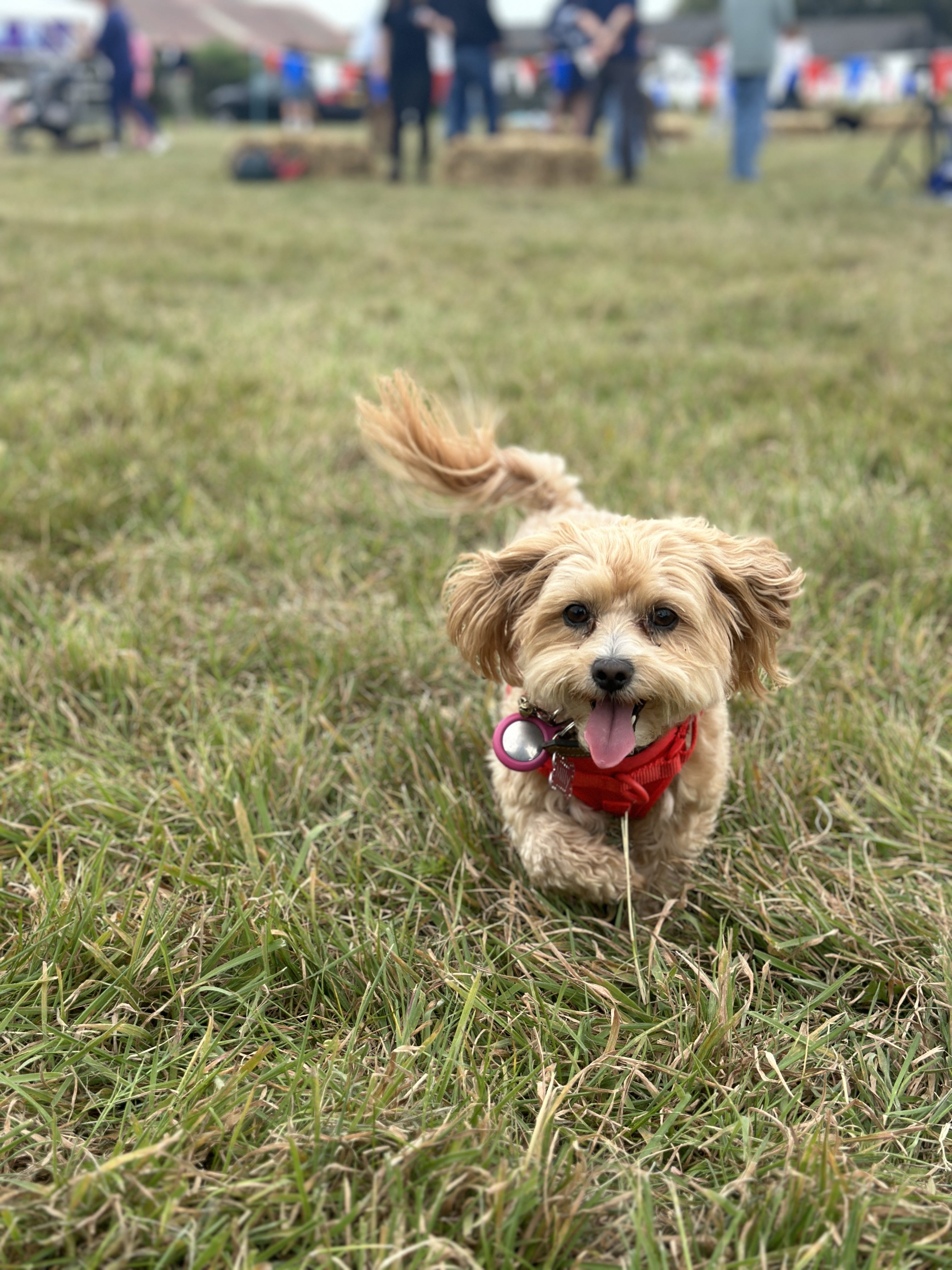
Right, Milly’s at the door and I’ve got roughly nine ideas to talk into my phone before they escape out of my ears.
Talk soon. Literally.
Nishma x
You’ll be Switched ON to: talking.
P.S. If you fancy trying the thing that started all this, my referral link gets you a month of Wispr Flow, free: wisprflow.ai/r?NISHMA1. Yes, it’s a referral link. No, Milly still doesn’t get commission.
I love this! Also a great fan of the tangents and the talking into my AI. It’s a great way of capturing thoughts immensely after a meeting as you’re walking to the tube, or for having lengthy musings whilst driving that then gets capture in coherent way.
Love this 🙌