


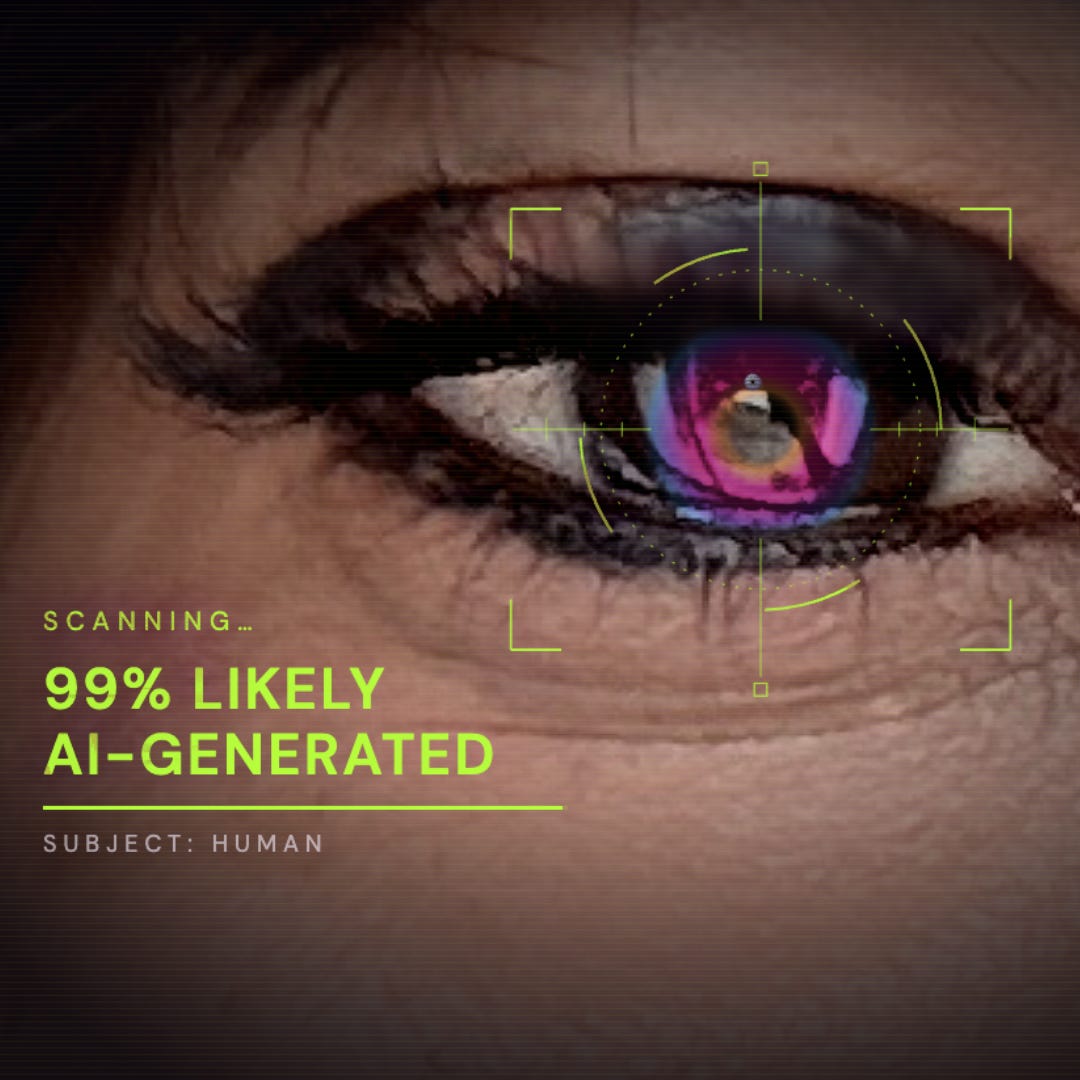
According to a machine, I didn’t write this.
Feed my work into Pangram or ZeroGPT and back comes a score announcing, with the calm of a man who has never once been wrong in a meeting, that AI made it. A verdict in four seconds. No appeal.
I should probably be offended. Mostly I’m fascinated, because the verdict tells you almost nothing about me and an enormous amount about the judge.
What actually wrote this
Let me tell you exactly how this piece got made. I talked. I always talk first. My best thinking arrives out loud, pacing the kitchen, dictated into Wispr Flow in one long ramble with the grammar of a woman chasing a thought downhill. Then I worked with AI to shape the ramble into paragraphs. The ideas are mine. The taste is mine. The swearing, very much mine. Machine assisted, not machine made.
I’ve also been on the wrong side of my own rule, so I’ll say that plainly. There was a stretch where I leaned too hard, hit generate once too often, and read back something published under my name thinking: who the hell wrote that? Nobody did. That was the problem. There was no one home in it. I didn’t need a percentage score to catch me. Taste caught me, the way taste catches everything.
More human than human
In Blade Runner it took a whole machine, a trained officer and a hundred questions to tell a replicant from a person. Pangram reckons it can manage it from a paragraph. You’ll remember things rarely ended well for the person on the wrong end of a false result.
The false results are the story here too. Students failed. Careers quietly ended on the say-so of a probability. These tools carry a narrow idea of what human writing looks like, and an awful lot of humans live outside it: people who write through assistive technology, dyslexic and neurodivergent writers, anyone working in a second language, and, quelle surprise, a great many women. “99% likely AI-generated,” says the dashboard, of a paragraph someone dictated word by word through the tech that lets them write at all. Polish reads as fraud. Difference reads as deception.
The test isn’t detecting machines. It’s detecting distance from its own average.
The arms race
Meanwhile, over on the other side of the ledger, pure pantomime. Humaniser tools. Writers A/B-testing their own personalities. Perfectly good sentences roughed up on purpose, em dashes purged like contraband, all so a scanner will believe a person was present.
We are now writing worse, deliberately, to pass a robot’s test of humanity.
Thirty years of the internet and that’s the sentence we’ve arrived at.
The unfashionable rule
I spent ten years at Google watching a version of this film on a loop. Every time the algorithm twitched, a cottage industry of tricks sprang up to charm it: keyword stuffers, link farmers, gamers of every update. Each of them won a season. None of them won a decade. The work that survived the whole era was embarrassingly unfashionable: good writing, made for a specific reader, by someone who understood them. That rule outlived every algorithm Google ever shipped, and it will outlive Pangram too.

A million verdicts
As for the slop the detectors were built to catch: we’d already caught it. Nobody scrolled LinkedIn thinking, gosh, I genuinely can’t tell whether this listicle has a soul. You knew. It didn’t sound like a person, you were irritated, and then, crucially, half of us engaged with it anyway. Shit content is shit content, and it was shit long before AI turned up to industrialise it. Sludge is a demand problem. The feed serves what we feed.
LinkedIn knows this, which is presumably why the feed now comes with a button. Three dots on any post and you can file your verdict: “seems like AI slop”. No machine, no trained officer, no hundred questions. One tap. Over a million people have pressed it in its first three weeks, by LinkedIn’s own count. Fewer than I’d have guessed, honestly, given the state of the average scroll. Still: a million verdicts.
Did anyone in that product meeting believe it would only ever be pressed in good faith? Buttons like this get pressed on competitors. They get pressed out of spite at 11pm. They get pressed, I’d put money on it, on women, because I’ve seen what already lands in the comments under women’s posts. I’ve been told more than once, always by a man I’ve never met, that I didn’t know what I actually wanted to say. He did, apparently. He always does. Imagine handing him a button. LinkedIn says there are safeguards, that no single press decides anything, and I believe them, because you only build safeguards for a thing you know people will do. Spare a thought for the wrong presses that land anyway. Somewhere right now a person is losing sleep, or losing clients, or worse, over a verdict a stranger reached before finishing her first paragraph.
Are we just judging style over substance now?
My plea
Starve it instead of scoring it: don’t click it, don’t rage-comment on it. Judge writing the way you judge company: did it teach you something, did it make you feel something, is anybody home? If you’d like your writing to read more human, skip the humaniser tool and go the long way round. Say it out loud first. Take your brain somewhere interesting and let it react to things. Work with AI as an extension of your brain, never the author. A detector can’t score any of that. Readers can, and they’re the only test that was ever worth passing.
And if this essay comes back 100% AI? Good on AI. It’s never written anything this good in its life.
One question before you go, for the next time you’re tempted to sand a sentence down to pass: how much of your own voice would you trade to satisfy a test built by someone who has never read you?
Nish x
I’m Nishma, and I help people get Switched ON to AI. Less overwhelm, more time and freedom, and a brand that stays unmistakably yours. If you’re midlife, brilliant, and tired of being told you’ve missed it, you’re exactly who I do this for. Come and find out more at nishma.co.