
Welcome to Day 18 of the challenge.
Most audience work is fiction.
You sit down, invent a woman, give her an age and a job and a fondness for a glass of wine on a Thursday, call her a persona and write to her forever. The trouble is she doesn’t exist. So everything written to her lands as generic, because generic is what you get when you write to a made-up average.
You don’t need to invent her. You’ve already met her.
She’s in your inbox. Your DMs. Your comments. The replies to your last newsletter. The people who actually buy from you, read you and write to you are telling you who they are, in their own words, every week. Today Claude reads the evidence and finds the pattern.
One honest thing first. This isn’t a replacement for proper audience research. If you’ve done the deep work, segmentation, interviews, the real thing, keep it. What today gives you is a sharp, evidence-based brief you can hand any AI so that everything it helps you make for your audience lands closer to home. It sits alongside the proper work. It doesn’t pretend to be it.
A word before we start
The reason this works is the same reason the voice profile worked on Sunday. You don’t tell AI who your audience is. You show it the evidence and let it find the pattern.
A description of your audience is a guess dressed up as a fact. The actual words real people use when they write to you are not a guess. They’re data. Claude is very good at reading a pile of real messages and telling you what keeps coming up: the same worry, the same phrase, the same question asked five different ways.
Step by step
Step 1. Gather the real evidence. Pick whichever of these you can get to easily:
Twenty or thirty real messages people have sent you. DMs, comment replies, emails from readers or clients. Copy the text into one file. Strip out surnames and anything identifying as you go.
Your email, if you’ve connected Gmail (Day 7). Claude can read the recent ones for you, no copying needed.
A list of clients or subscribers if you keep one, even a rough spreadsheet.
Don’t polish or cherry-pick the nice ones. The annoyed message and the confused one are often worth more than the gushing one.
If you’re pasting messages in, save them to your reference folder as audience-evidence.md.
Step 2. Open Cowork in your desktop app, pointed at your Switched-On folder. Opus for this one. Make sure CLAUDE.md is at the top.
Step 3. If you’re using pasted messages, paste this to Claude:
Read the file reference/audience-evidence.md. These are real messages from people in my audience. Find the pattern. Tell me: who keeps showing up, what they actually ask for, the exact words and phrases they use, the worry underneath the question, and what they never say but clearly feel. Don’t smooth their language into marketing speak. Quote them where it’s telling. Ask any clarifying questions before you begin.
If you connected Gmail and want Claude to read your inbox instead, add this line at the start:
Read the last fifty emails I’ve received from people who aren’t colleagues or suppliers. Treat them as audience evidence. And... (then add the rest of the prompt above)
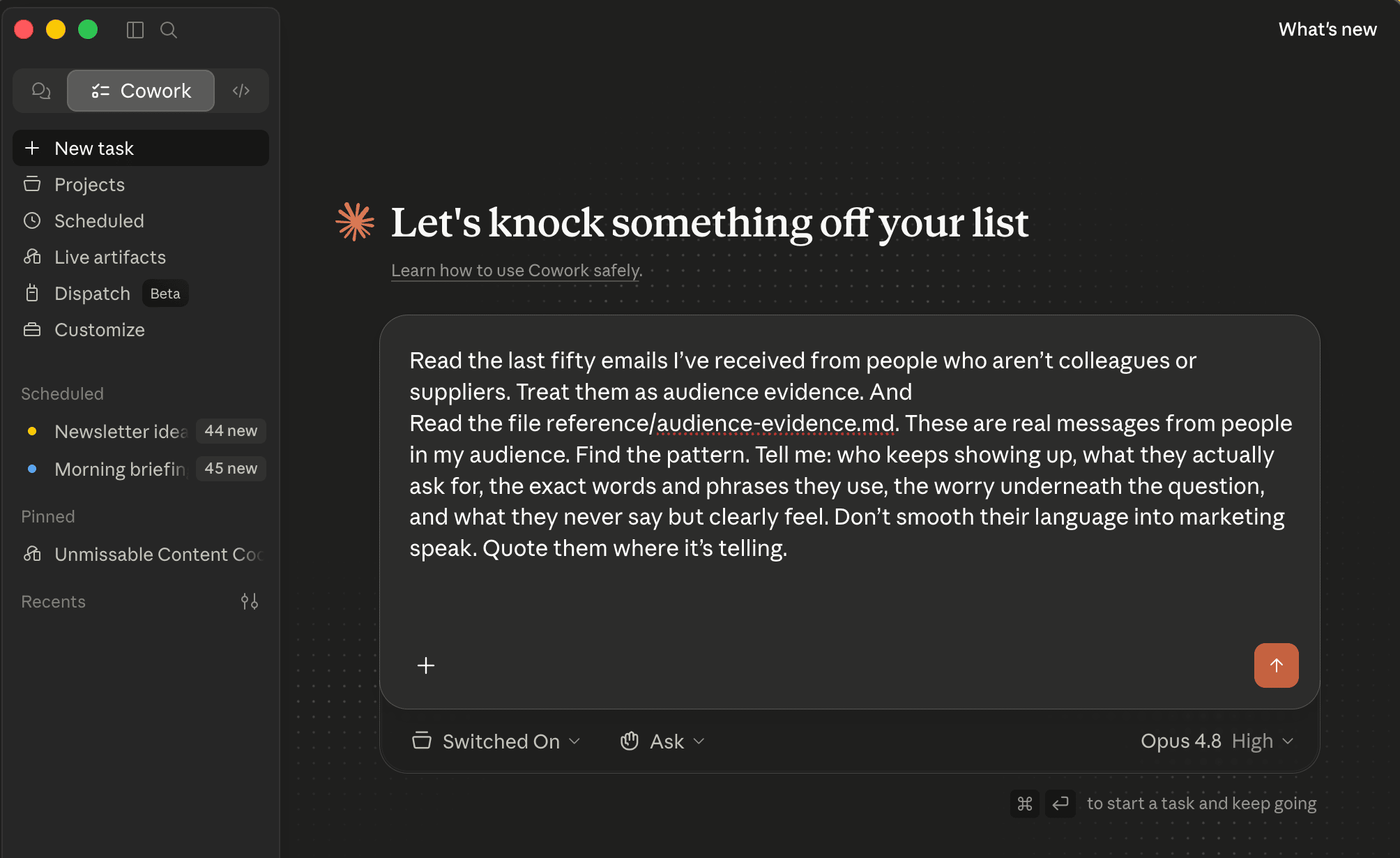
Step 4. Read what comes back.
This is the bit that lands. You’ll see your audience described in their own words, not yours. The question you didn’t realise everyone was asking. The phrase three different people used. The thing they’re all quietly worried about.
Step 5. Now sharpen it on one real person. Patterns can still drift into a blur. So pin it to someone real. Paste this to Claude:
Now pick the one real person from this evidence who most represents the pattern, or let me name her. I’ll tell you about her. Then write me audience.md: who she is, what she actually does, what she’d say at dinner that she’d never post, what she’s scrolling past, and what she genuinely wants from me. Use her real words from the evidence. First name only, nothing that identifies her.
Answer any follow-ups honestly. The uncomfortable specifics are the useful ones.
Step 6. Save it into the spine. Paste this to Claude:
Save the final file as audience.md at the top of my Switched-On folder. Then update CLAUDE.md with a line: See audience.md for who I actually serve, built from real evidence.
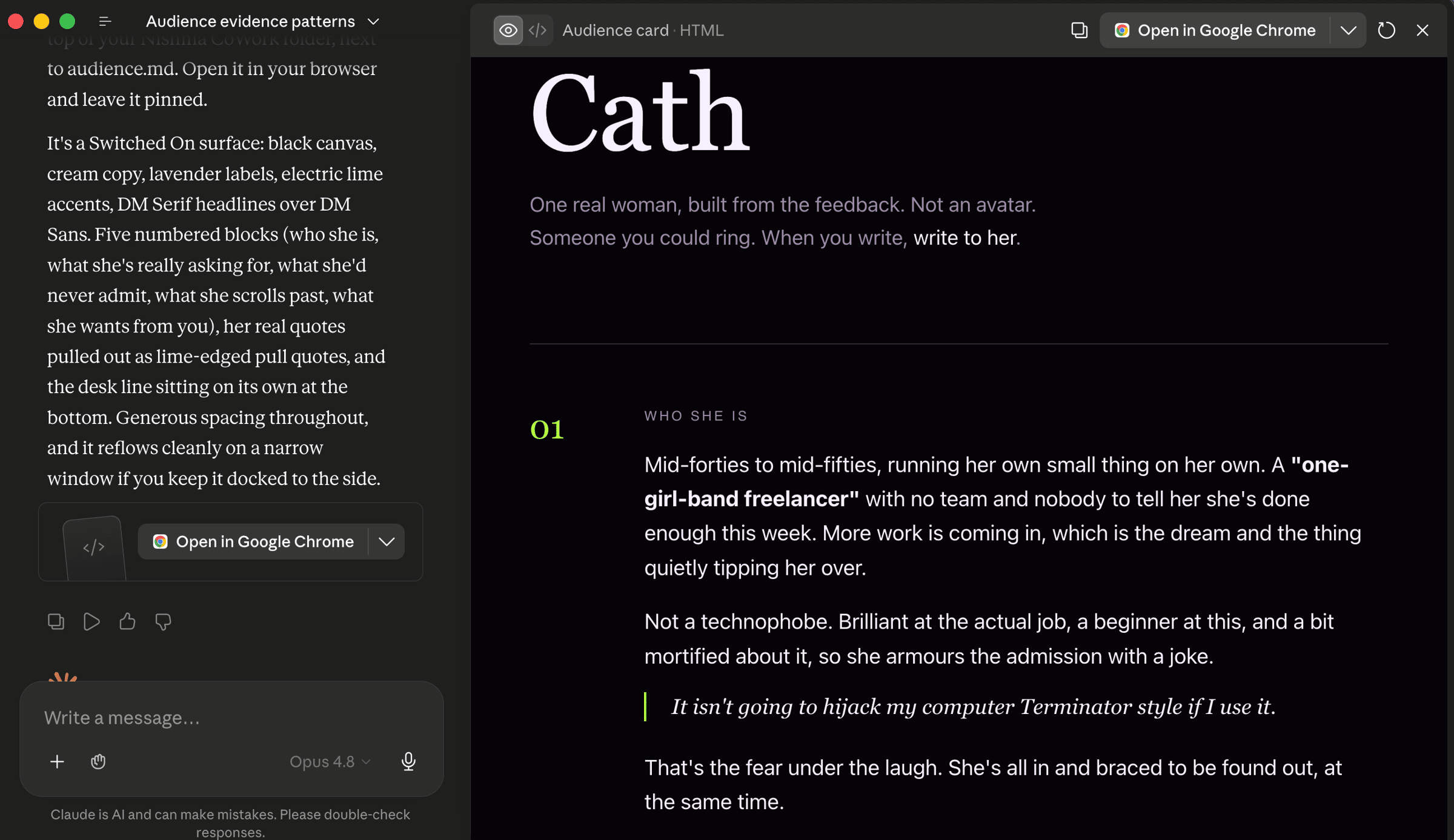
Step 7. Optional, build her a card you can keep open while you write. Paste this to Claude:
Take audience.md and make a single-page HTML card I can keep open in my browser. Clean, dark background, generous spacing. Five blocks: who she is, what she’s really asking for, what she’d never admit, what she scrolls past, what she wants from me. Save it as audience-card.html.
A safety note
These are real people. Treat the file with care.
FIRST NAMES ONLY. No surnames, no employer, no address, nothing that would identify someone if the file ever leaked. Describe her role, not her organisation. If the person who best fits is genuinely private, someone who confides in you, use a made-up name. Claude is using the pattern, not the identity.
If you used Gmail, the evidence stays in your session. Don’t save anyone’s raw emails into a file you’d share.
What you’ll notice
She comes to mind every time you sit down to write now. Not a demographic. A person, with a real worry and a real way of talking.
You’ll also notice your own language change. Your sentences get shorter. Your examples get specific. The jargon falls away, because she’d roll her eyes at it. That’s the whole point. Write to one real person and the others like her lean in.
Why this works
Real beats representative. A persona is an average, and nobody is an average. The actual words of twenty real people carry the texture an invented profile never will, the specific fear, the specific phrase, the specific thing they’ve tried and given up on.
You had the evidence all along. You’d just maybe never sat down and read it as ‘evidence’. Claude does the reading and finds what repeats.
Key takeaway
You don’t invent your audience. You read it back from the people already there.
Real messages in. A pattern out. One real woman to sharpen it on. One audience.md at the top of your folder, built from evidence, not a vibe.
Where this is heading
Tomorrow, the money side. And we don’t just write about it, we build something that does the maths and helps us with key business decisions.
Tomorrow on Switched On
Day 19: Build the money model your business actually needs.
No finance degree required. Show Claude the numbers, ask the right question, and walk away with a working model you’ll actually use.
Nishma x
P.S. How did today land? Three buttons, thirty seconds. Tap here
Catching up? Days 0 to 17 are on the Switched On Substack archive HERE.
Got a friend or a colleague who this might be useful for? Send her to nishma.co/30daychallenge
SwitchedOn #SwitchedOnAIChallenge