


We keep asking whether midlife can keep up with AI. It is the wrong question, and a bit insulting. The better question, the one the industry seems determined not to sit with, is whether AI can keep up with midlife. Look at who it films, who it markets to, who it builds its whole personality around, and the answer gets a little embarrassing.
It is not midlife that is struggling to stay relevant. It’s the technology.
This is not a piece about ageism, though ageism is the water it swims in. It is about something more damning. The people building AI have stopped watching. The industry studies generations for a living, and Gen X is nearly a third of the population and four per cent of that research.
Four per cent.
Age moved on. Relevance moved on. The tech didn’t.
We have rewritten what fifty looks like, and nobody sent tech the memo. A woman in her 50s is now Jennifer Lopez, or Victoria Beckham, or half the names you would be startled to learn are the age they are. The over-50s are back on the Ibiza dance floor, out-dancing their own children (yep that’s me!).
My own fifties look nothing like my mother’s did. Midlife is richer than it has ever been, living longer than it has ever lived, and holds the spending power, the networks and the decades of pattern recognition, the exact wisdom you would want teaching these machines to be less stupid. The culture worked all this out years ago. The industry is the last one in the room to notice.
This is where it stops being a marketing quibble. If we were talking about a handbag advert, fine, cast whoever shifts the units. But AI is not a handbag. It is a product rewiring how we work, how we run businesses, how we care for our parents, how we hold on to our jobs. Who it pictures using it decides who dares to use it. You do not lose a generation by barring the door. You lose them by never once casting them in the story. And this generation, the squeezed, caring, business-building, quietly furious midlife one, and especially its women, is the last one you would want to lose. They are the ones driving the change.
The room
I watched all of this play out in June, in the loveliest possible setting. It was my first ever B2B creator lunch, in Cannes, hosted by OpenAI, and I don’t think there have been many of those before. A brilliant room. A gorgeous terrace, mostly women, wildly clever, and I will happily admit I was a little starstruck, because several of the people there had been my actual teachers: the creators whose work first showed me what these tools could do. Marina Mogilko, the Silicon Valley Girl herself. Tara Keeney. Maggie Ma. Monica Khan. Jess Ramos. Jean Kang. They had earned their place on that terrace. So, it turned out, had I.
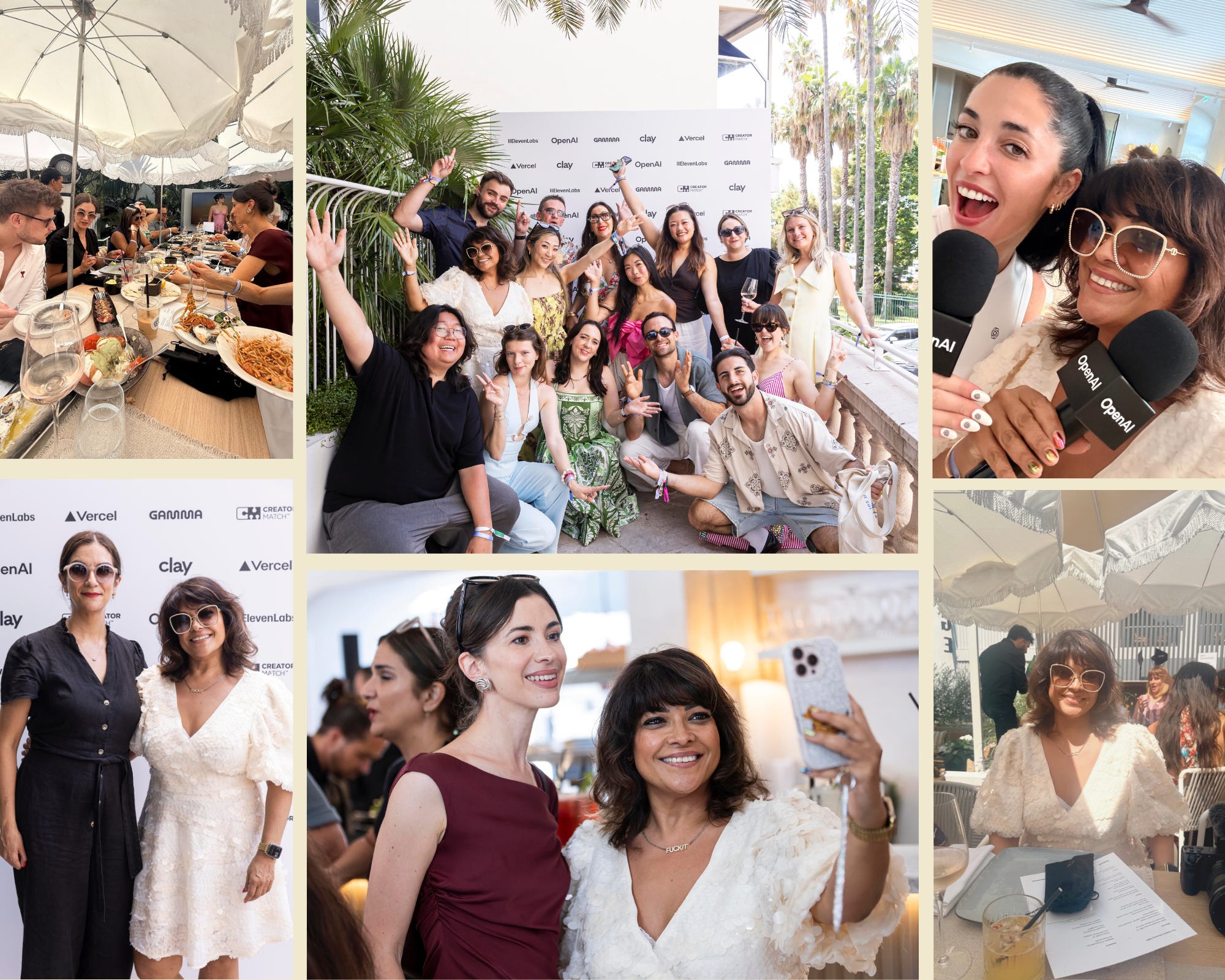
I want to name who got me there, because it matters, and because she has earned it. Leila Woodington put that lunch together, and I have watched her blaze a trail for years: from the day I first met her at Meta, through Snap, through VEED, and now OpenAI. Every move, she has quietly redefined how this industry markets itself, warmer, sharper, more human. She is one of those rare people in tech who simply gets it, does beautiful work, and is glad to go against the grain to do it. Rooms like that one do not open by accident. It is the deliberate championing of people like Leila that gets someone like me through the door, and slowly widens who the whole industry can see. It was, on her part, a clever door to open, because AI runs on trust, and trust travels through people you already believe.
Standing there, I realised I was just about the only midlife creator in the room. It didn’t land as a slight, though. It landed as a job. If I am the only one of us in a room like that, then someone has to carry what happens in it back to the millions who will never be invited in. Someone has to translate it. That someone might as well be me.
I know this game from the inside, by the way. I spent ten years at Google, and we were forever obsessed with Gen Z, sometimes to the point of parody. It was gospel: win them young and you win adoption, coolness, scale, a customer for life. I understand the logic completely. I would just love to watch it grow up. You can see the blind spot most plainly in the advertising. Watch the AI ads. Clock the casting. The demo films, the launch films, the partnerships: everyone is 23, luminous, building an app in a dorm room. Sometimes younger. Even the Advertising Standards Authority has noticed, 44 per cent of us reckon older people barely appear in advertising at all, and that is before anyone points a camera at an AI launch. There is something faintly desperate about the most powerful tool of our age trying quite this hard to be cool.
Tech treats midlife like a ghost demographic: happy to bank our subscriptions, wary of putting our faces on the brand in case the software starts to look its age.
Which is how a woman in her 50s who is evangelical about AI still gets filed as a surprise. A charming exception. The plot twist, never the lead.
There are midlife creators all over tech doing this brilliantly, and brands getting it right, showing a real spread of ages and lives and uses. I am not pretending otherwise. But the norm, the thing I hear from my community and my clients every single week, is a quieter feeling: that this new world is something they are intruding on, not something they were invited into. That feeling decides who steps forward and who quietly backs away.
The midlife people I meet tend to split into two camps. The senior men who say “oh, my team handles that” (the corporate equivalent of claiming you’ve read Ulysses), then corner me by the lifts to ask for actual help. And the women, most of them, who say “I’m so far behind”, which is only “too late” in a nicer coat. Both are bluffing. Both are wrong.
We’re already here
The truth is we are already here. Look past the headline that more Gen Z have poked at a chatbot, and at the numbers that count. At work, it is millennials, not Gen Z, who reach for AI the most. Older users are folding it into the tools they already live in, without making a personality of it. The creator economy everyone still pictures as a teenager doing a dance? Gen X and older are its fastest-growing part.
We did not miss the revolution. We just didn’t film ourselves having it.
Now the half I actually want to celebrate. Gen X is the most quietly adaptable generation alive. We grew up analogue and taught ourselves digital with no manual and no helpful teenager. We are the last who remember the world before the internet and the first who had to build a life on top of it. We rewired for email, then the web, then mobile, then social, and now this, every single time without one advert made for us, and kept our jobs, our families and most of our marbles throughout. That is not a generation struggling to keep up. That is the deepest muscle memory for change on the planet.
Staying power is the whole point of us. We just don’t shout about it.
The numbers, and the Fuck It
Put the numbers next to the temperament. The average founder of a genuinely fast-growing company is 45, and a fifty-year-old is likelier to build one than a thirty-year-old, not less. Women are starting businesses in record numbers, a great many of them over 50. Midlife holds more of the wealth, lives longer, and carries the single most underrated force in commerce: a woman in her 50s with a fully operational Fuck It attitude.
This is where AI stops being a toy and starts being a lever. Venture capital still hands all-female founding teams around 2% of the money, which is less a gap than a rounding error with a God complex.
Can’t raise for a team? Build one out of AI agents.
Told your idea won’t fly? Prototype it by Friday and put it on the table, working.
Can’t buy your time back? Work with AI daily until it runs the parts of your life that were never the best of you.
That is what I watch happen, women in particular building the things that should already exist, because the people in charge never had the problem, and nobody funds an ache they have never felt.

Why I call myself a Midlife Creator
This is the work I am proudest of. Every leap in technology has needed people who can translate it, distil it, make it relatable, bring it to life for everyone standing outside it. That is the job I have handed myself. I call myself a Midlife Creator, and I mean it as a flag, not an apology: a representative, a protagonist, the one asking the daft, curious questions out loud. Not another prompt list, but the confidence to treat AI as a sparring partner and the craft to make it sound like you and not like everyone. The people written off as too far behind turn out to be the fastest, because they know exactly what they want it for. Fluency without a point is just noise. These people have a point.
Not a plea. A business case.
So this is not a plea. It’s a business case, aimed up, at big tech and whoever is writing the casting briefs. The best already understand it, and Leila and the rooms she builds are proof. I’m talking to the wider machine. Broaden who you picture. Not as a favour, not as a hashtag, and not because it would be a nice thing to do. Because you are leaving the wealthiest, longest-living, fastest-growing customer base in the market sitting outside your shop window, and because you are building the tools the whole of society now runs on.
There is a colder, cleverer reason too. A model is only ever as rich as the range of people teaching it. Feed it a narrow band of young, similar voices asking similar questions and it learns a narrow band of the world, then hands it back to you, averaged and beige. Bring in older, wider, stranger voices, the odd questions, the lived-in context, the instincts built over a whole life, and you get a better model. Fuller. Stranger. More useful.
The range of people teaching it is not the nice bit on the side of the intelligence. It is the intelligence.
So ignore midlife women at your peril: your fastest adopters, your most underrated founders, your richest untapped market, and the sharpest voices you could put in the room where the model is trained. That is not a box to tick. That is the growth story you keep saying you want.
And the useful part, for you. Somebody is already translating you to that audience. Creators like me are doing it every week, mostly unpaid, because somebody has to. The audience I speak to trusts me and does not yet trust you.
You cannot buy that with a launch film. You can only borrow it from someone who has already earned it.
The bit I’ll say plainly
If you are the one sitting there certain you’re too far behind: I see you. I was you once, nodding along in a meeting, quietly drafting my exit. You are not behind. You are early.
Being written off does not feel like being ignored. It feels like being erased. It is watching an advert for a tool you use every single day and clocking that nobody in it is you. It is being Tipp-Exed out of the story a chapter early, by an industry that has quietly decided the good part of your life already happened. Well. I’ve done the maths on that too. I’m only halfway there.
This is the middle of the book, not the acknowledgements, and the back half is where it gets good.
It’s not too late. It’s barely gone breakfast.
So save me a seat at the next lunch. I’ll be the one raising the average age and bringing the disco. 🪩
Nish x

I'm Nishma, and I help people get Switched ON to AI. Less overwhelm, more time and freedom, and a brand that stays unmistakably yours. If you're midlife, brilliant, and tired of being told you've missed it, you're exactly who I do this for. Come and find me at nishma.co.